
Closet Drama: Shakespeare and the Politics of Style
By Julia Isabel Robles
Men wearing dresses is a concept that is far from novel. Long before it was seen on the runway, in pop culture, or within conversations regarding gender expression, it was something expected and ordinary on the stage of historical plays. At the time that Shakespeare was an active playwright during the late 16th and early 17th centuries, all actors were male, including those who played female parts. In William Shakespeare's play titled As You Like It, the idea of identity as a costume to be performed, altered, and put on is central to the play’s humor and social insight. He builds this entire comedy around using fashion as a disguise and a way of transformation, utilizing clothing as a tool to reveal how self-expression and identity are actively constructed concepts as more than merely a simple costume choice.

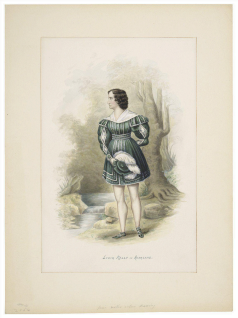
For the original audiences of Shakespeare's plays, Rosalind’s constructed guise of Ganymede serves as a wink to the audience he knew were well aware that every female character in his plays were performed by a man. The situation was a shared act of recognition that he was able to play with the public. As a result of every spectator's awareness that the heroine Rosalind was a female character pretending to be a man played by a male actor, Shakespeare cleverly engaged the audience in a layered game of perception and understanding, inviting them into the disguise and to be privy to Rosalind’s secret. The audience’s knowledge of Rosalind’s gender expression becomes a part of the play itself, bridging the divide between public and play to become one in the same. Utilizing conceptions of gender as a form of expression, Shakespeare subverts audience expectations, demonstrating how identity can be performed, challenged, and playfully destabilized through clothing and fashion.
The history behind men playing women’s parts on stage comes from the cultural norms around the practice rather than any formal laws. Although it wasn’t a hardened rule, it was widely accepted enough not to be questioned at the time. Allowing the stage to be one of the few places where cross-dressing was normalized and even encouraged. Meaning the power of Fashion alone was able to indicate the gender of who they were playing, displaying the irony of how, in As You Like It, Shakespeare turns gender into a costume to be taken on and off as one pleases. Not only is Rosalind able to slip in and out of this costume when she chooses, but she also utilizes the opportunity to gain control of her relationship by testing her lover without his knowledge through lessons using the constructed character she pretends to be.

In a program book from the play performed called “As you like it: The play, the history, the concept; a Dramaturgical Approach," has a whole section dedicated to the costumes in the play and states, “We hope that the audience takes delight in the visuals through a rich palette of color, texture and movement that feeds the imagination, upholds the tradition of spectacle in the Mary Rippon Theatre, and forwards the holiday mood of As You Like It.” (Deborah Bays 15) This illustrates how important the public’s opinion of costumes is in relation to how the play is perceived. From reading this section, it is clear that long after Shakespeare’s death, the relationship between the audience and the costumes they see on stage is central to the meaning of the play and can make or break the meaning. This presents the idea of fashion as a form of communication between the stage and its audience that can deepen the connection between the concepts being conveyed.
Despite the many cultural changes our world has undergone since this play’s conception, the rigid roles that gender expectations present remain as a constant, allowing its message to remain the same but evolve along with its audience as ideas surrounding gender roles change. For example, today the role of Rosalind is often played by women as rules surrounding actors have changed; however, often with As You Like It and other Shakespeare plays, the roles of gender are still experimented with as they are now seen as mere suggestions rather than rigid guidelines. By shifting gender identities, these versions achieve a similar subversion of ideas surrounding gender and gender expression, aligning with Shakespeare's original intentions of playing with the audience’s knowledge, where here the plays are both altered with the knowledge that their audience is aware that the gender of the roles is being altered. Despite how the concept of cross-dressing has become much more widely accepted, producers of Shakespeare plays have still found ways to subvert audiences' expectations in the same way that As You Like It did for audiences of its day.
Something that remains constant about the play is its ability to allow its actors to play with gender themselves without worry of scrutiny or enforcement of gendered expectations. From when the play was first written, many actors were able to safely explore their identities through acting in Shakespeare's plays, taking on the role of a woman in a way that was considered socially acceptable. This is further emphasized by the role of Rosalind, where they are able to play both male and female parts centuries later, and even today, now that her role is intended to allow for a female actor to not only dress in but also take on the character of a male, along with Rosalind herself. Although the play and character are, of course, fictional, the fact that these actors are able to surpass usual expressions of gender is not. Which is notable, considering how, even today, breaking these rules often risks creating waves. To be able to do something so subversive yet subtle enough that it often isn’t questioned is an accomplishment that Shakespeare should be celebrated for, especially considering how long ago he was able to achieve it.
Beyond simply a disguise, Rosalind is able to take power in designing her new look and persona of Ganymede in line 125 she states, “A gallant curtal-ax upon my thigh, A boar-spear in my hand, and in my heart.” Emphasizing her control over this expression, making it her own rather than simply hiding herself out of fear or necessity. She is able to use her constructed character through careful accessorization to gain a better sense of herself rather than burying it under clothing. It also plays on the satirical expression of exaggerated masculinity presented in the small details of fashion, playing up the idea that gender is a performance.
By allowing the audience to have the accessed privileged to Rosalind’s secret, Shakespeare is transforming spectators into active participants in the plot that is unfolding in front of them. As a result of the audience being able to see right through Rosalind’s disguise, while the rest of the characters are oblivious, this signals how identity is something to be
performed, manipulated, and sometimes even misread by others. Though this scene comes off as comical and unserious, its real-world implications remain accurate and
evergreen in how relevant they have remained in society through every change in culture throughout generations.
Overall, Shakespeare’s As You Like It utilizes costumes, subversion of gender roles, and audience insight in order to create and convey a level of irony surrounding how identity is something that can be transformed, performed, and taken on and off, much like clothing itself. The character of Rosalind’s ability to take control of her narrative and love life through her constructed identity as Ganymede demonstrates how it's possible to utilize gender stereotypes centered around fashion to gain agency rather than to lose it. The audience's priviness to this information allows them to transcend their role as the public to become a part of the play as they participate in her performance, allowing the play to become a collaborative exploration of identity for the actors, audience, and characters alike.

0 Comments
There are no comments yet. Be the first one to post one!