
Have Theme Parks Become Too IP-Focused? By Emma Flores
By Emma Flores

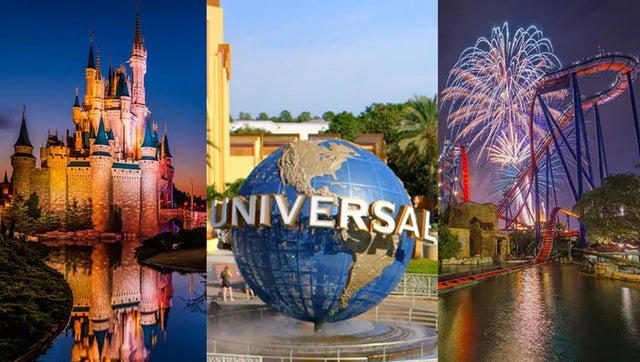
In 2007, it was announced that Universal Islands of Adventure was developing a new area themed after The Wizarding World of Harry Potter, set to open in 2009. After a two-and-a-half-year construction period, The Wizarding World of Harry Potter-Hogsmeade would officially open on June 18. 2010. The area would prove to be an instant success and was praised for its immersion and detail. But little did theme park goers know that this would change the theme park industry playbook down the line. As a Floridian, I can proudly say that theme parks are a staple in the state, the most notable being Orlando’s Walt Disney World, Universal Orlando, and SeaWorld Orlando. I have recently noticed a recurring criticism about the current state of the parks: they focus too much on IPs (Intellectual Properties) rather than original concepts. This criticism comes in the wake of Hogsmeade opening in Universal Islands of Adventure.
In later years, Disney would eventually follow in this trend of overlaying existing IP onto older rides, also known as retrofitting. Two examples include Epcot’s Maelstrom converting into Frozen Ever After and Guardians of the Galaxy: Mission: Breakout! replacing Tower of Terror in Disney’s California Adventure. It is also worth noting that before Hogsmeade’s opening, Islands of Adventure hosted the roller coaster Dueling Dragons, themed after Arthurian myths, before ultimately being replaced by Hagrid’s Magical Creatures Motorbike Adventure. Just to be clear, this criticism has mostly been aimed at Disney, since it contradicts the company’s founding philosophy. Before Galaxy’s Edge and Toy Story Land, there were only Frontierland, Tomorrowland, and Adventureland, completely original and not tied to any particular film franchise. As the Disney parks developed, Walt Disney’s goal was to create an environment centered on imaginative, story-driven lands.
It was never about familiarity; it was about exploring something new. Now you might be wondering, "What's the big deal? A theme park is just a theme park." That is true to some extent and, to be fair, theme park IP isn't new. Back in the 90s, Six Flags theme parks hosted Batman: The Ride, obviously themed after the Dark Knight. This was because Warner Bros., which owns the DC Comics IP, was the parent company of Six Flags. Heck, when Universal Studios Florida first opened, its slogan literally said: “Ride the movies”, since most of their attractions were themed after popular IP. However, an attraction will immediately change its name and theme once a company loses the rights to an IP. In his opinion piece “The intellectual property arms race and the battle for supremacy”, Lance Hart writes that a great example of this was when Cedar Fair acquired Paramount Parks and removed any IP related to Paramount across its parks.

When Universal Studios Florida first opened in 1990, most of its attractions were themed after popular IP, such as E.T., Back to the Future, Jaws, and King Kong.
As of today, Cedar Fair and Paramount Parks are both defunct, the latter being merged with Six Flags in 2023. While attractions like these have made an impression on parkgoers and tourists alike, it wouldn’t be until Wizarding World’s opening that it made a significant impact. The reason Wizarding World was so impactful is that it wasn’t just a single attraction themed to Harry Potter; it was a full-blown land dedicated to the franchise. You could actually drink Butterbeer, have your own magic wand, and even board the Hogwarts Express to visit each park. It felt like you were actually in the world of Harry Potter. In fact, park attendance increased significantly after Hogsmeade opened at Islands of Adventure. This would eventually lead to the opening of Diagon Alley in 2014 at Universal Studios Florida and, more recently, the Ministry of Magic at the fairly new Epic Universe.

Universal Orlando currently has three lands themed after the Wizarding World of Harry Potter. The most recent is Ministry of Magic at Epic Universe, which opened in 2025
So what really is the big deal? We can just enjoy the park without being bothered by the enormous amount of IP and call it a day, right? Well, that only works if you completely ignore what is being lost every time a retrofit happens. In his article “Theme Park or IP Park?” Ryan L. Terry writes that while building lands based on popularly established IP looks and sounds like a great idea, there is a darker side that won’t be realized and observed for years. He uses A Bug’s Life as an example of the lengths Disney Parks went to remove and rebuild. It’s Tough to be a Bug was a 3D film attraction themed after A Bug’s Life that was present at Disney’s Animal Kingdom and Disney’s California Adventure. In 2018, the attraction was replaced by Web Slingers: A Spider-Man Adventure in California Adventure, while being replaced by Zootopia: Better Zoogether at Animal Kingdom in 2025. Terry goes on to write that this moves away from the traditional theme park concept to an IP park, arguing that it does not make for an overall theme if a park consists of an IP collection.
Not only does filling a park with IP pose a loss of creative freedom, but it also increasingly homogenizes every one of them. But why are they doing this? Why has the theme park industry seemed to move away from original concepts and prioritize recognizable IP? The answer is, unsurprisingly, money. Turns out if you develop an entire land themed after Harry Potter, Star Wars, or Marvel, it brings in revenue. Original concepts? Too risky. Existing IP? Now that’s a true moneymaker. It’s really no wonder why parks other than Universal jumped on the bandwagon of building entire lands dedicated to well-known IP. If it wasn’t for Wizarding World, we wouldn’t have gotten Star Wars: Galaxy’s Edge, Avengers Campus, or Super Nintendo World. At the same time, we didn’t really realize what it meant for the majority of theme parks. So what does this mean for the industry in general?
While yes, it is true that the theme park industry has prioritized established IPs more than original concepts, it’s not entirely true. Take Dollywood for example, aside from being built around Dolly Parton herself (RIP), the park also highlights 1950s nostalgia and Appalachian culture. Then there’s Europa-Park in Germany, which features an area entirely dedicated to fairy tales by the Brothers Grimm, as well as areas representing other European countries. Universal attempts to balance IP with originality in its newest theme park, Epic Universe. While the park does feature well-known IP such as Nintendo, Universal Monsters, and How to Train Your Dragon, an original concept comes in the form of Celestial Park, the central hub themed after astrology. Overall, it’s safe to say that theme parks that don’t revolve around popular IP aren’t completely dead.

Not all theme parks revolve around existing IP; Dollywood is one of them. The park is themed around 1950s nostalgia, Appalachian culture, and, of course, the late Dolly Parton herself.
Theme parks are called such because they are based around a central theme. Disney’s Hollywood Studios: The Golden Age of Hollywood; Universal Islands of Adventure: Fantasy and adventure; and SeaWorld: The ocean. Now, yes, adding in a well-known IP can prove to be lucrative but also a missed opportunity for original ideas. I am not saying that IPs don’t belong in theme parks; don’t get me wrong, I love the immersion and detail they put in. What I’m saying is that there needs to be a balance. Existing IPs and original ideas can exist without overshadowing the other (see Epic Universe). The industry seems to have forgotten that theme in theme park didn’t necessarily mean Mickey Mouse or Harry Potter, and as a result, original concepts have become scarce. If that continues to be the case, then we might actually end up with IP parks rather than theme parks.
Sources
Hart, L. (2025, November 27). The theme park IP arms race. Blooloop. https://blooloop.com/ip-arms-race/
Terry, R. L. (2018, November 12). Theme Park or IP Park? R.L. Terry ReelView. https://rlterryreelview.com/2018/11/12/ippark/
0 Comments
There are no comments yet. Be the first one to post one!