
The Art of Staying Awhile: A Summer in the South of France By Francine Lazo

On France, the American rush, and the permission to begin slowly.
For as long as I can remember, I believed that time was a tide already pulling away from me. It was never spoken aloud, but it rattled in my bones. It lived beneath every conversation about my future—in the gentle, relentless questions of what I would study, where I would go, whether the plan I carried was worthy of the years it would ask of me. The weight of these discussions followed me into classrooms, group chats, and late-night kitchens. I began to believe that my life was a race I was already losing.
Then I traveled to the south of France, and I rediscovered parts of myself—some of those parts being my stowed-away passions in the arts, specifically film, reading, and creative writing.
An Epiphanic Summer
I went to Aix-en-Provence to study French film, literature, and the many cultures of France. I knew I would learn about writing and technique. In class, we studied how a director uses space, how an empty doorway or a slow zoom-in can say what dialogue cannot. What I did not expect was to leave with one of the biggest lessons of all: how to live.
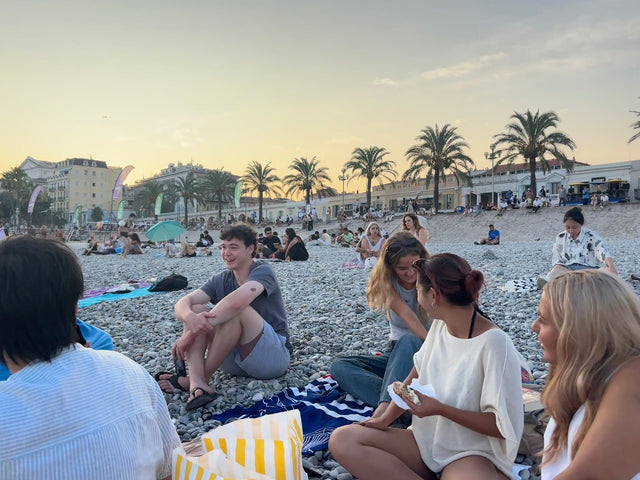
It began in glimpses—with flâneuring, getting lost on purpose. I walked not to accomplish a mission, but simply to walk, surrendering the map and letting the city and my senses lead. I followed a scent through winding streets until I discovered its source like a cartoon character. I followed the sound of live music until I found my friends and me in the town square, dancing before a drum set. From those wanderings, the rhythm of the days spilled into the evenings: dinners that stretched from seven until eleven, not a phone in sight, a pizza passed hand to hand while my raspberry daiquiri trembled and sloshed with every slap of a knee and burst of laughter. I boarded a high-speed train to Paris with people I had known for only a week, then walked mile after mile until our feet blistered. We gave ourselves to the warm water of Nice for six unhurried hours, and strolled through museums and local art studios, letting beauty find us wherever it chose to be.


Every day, people filled café tables, conversing over small cups of coffee and reading the newspaper, in no apparent hurry to be anywhere else. At night, they would roam the streets to chat and dance to the live music by the fountain. People of all ages were outside, together: grandparents swaying arm in arm, couples dawdling over glasses of wine, children weaving between the tables, and friends laughing in loose circles. No one seemed to be performing for anyone else. Everyone was simply present, enjoying one another’s company as though it were the most natural way to spend a life.


Yet the moment I felt the essence of taking a leap came on the cliffs of Cassis. One of the locals my friends and I had befriended took us to her summer spot in Forêt du CDL, in Les Calanques. It was raining, and we had to climb down the side of a cliff barefoot. One wrong step and you could slip and fall. I remember relying purely on my upper body strength, my momentum, and the static friction between my skin and every ledge and crevice, each handhold a small negotiation with the stone. When we finally reached the edge, I looked down and felt fear settle in my chest. My friends counted “three, two, one” four separate times, and four separate times my body refused to obey. I remember literally staring down at the water, every instinct pleading with me to retreat. And then I jumped. For one suspended breath I was weightless, and when I emerged from the water, I received a relief unlike any I had ever been given. The sea was warm, the rain poured steadily down, and above me a hazy rainbow arched across the canyon of trees and sediment—the whole scene felt like a painting, as though the world had been waiting to forgive my fear.

Through all of it—the wandering, the long dinners, the leaps—I met the most beautiful people: locals who were seasoned with existence, students from other countries, and people of varying French cultural nexuses. Each of them instilled the same encouragement: to truly breathe, to live, and to do what you love in life.
The End of the Unhurried
Coming back to the United States, I really had to reground myself and readjust to my reality. The small life I built there soon faded to a memory. There was no way to chase the highs and the peacefulness of it all. Traveling in the isolation of my car and my Spotify playlist, rather than walking among people and their chirps, was jarring—a quiet I never fathomed would feel so total; it felt less like peace and more like absence. I returned to my American university to the pressure to find a job and internship, and the expectation to have it together.
I spent the next couple of weeks aimlessly applying for everything I could, subjecting myself to the wallows of my own doubts. I was trying to set myself up to hold my own and support my family, and I felt the weight of it on my shoulders. All I wanted was to pursue the realm of books and create screenplays, but it felt impossible. As I reminisced about France, I thought of the films we had watched, like La Piscine (1969), which had reignited something in me: the sun-bleached villa, the glisten of water droplets on skin, the light so white and heavy it seemed to slow time, the still, glittering pool where desire and restraint circled each other in plain sight. But everywhere I turned, the people around me were landing internships in their fields or stepping into the very roles I had dreamed of in the arts. Their announcements glowed on my screen, each one a small door opening for someone else, and I congratulated them while something aching turned over inside me. I was genuinely happy for them, yet I could not stop measuring the distance between their lives and mine. Comparison is truly the thief of joy—it takes and takes, until nothing remains but the quiet certainty that I had failed.
And yet the truth remained: I have barely scraped the surface of life.
In the United States, I think it’s so easy to be manipulated by the rush to make loads of money and to compete with others. It may sound cliché, but it’s true: life is too short not to chase your dreams and pursue your passions, especially when there is so much of it still ahead of us. Things will fall into place eventually.
I Am Not Late to My Own Life
Here is what I am learning now, slowly, as France taught me to learn all things.
I have years. Have years to attempt and to abandon, to turn and begin again, to fail gracefully and rise toward something new. The woman who graduates this year is not my final form—she is only the next. I can write and edit while I work. I can study film while I build a career. I can change my mind at twenty-five, at thirty, at forty, and the world will not fall away beneath me. If anything, it may at last begin to make sense.
I’m not going to lie — anxiety still haunts me almost every day. But I have learned to receive it as I once received the long evenings in Provence—patiently, without hurrying it toward the door.
So here’s my two cents for you (and a reminder for myself): make the most of your time—not by filling every hour, but by inhabiting it. Linger. Lift your eyes. Say yes.
The cliff is only as terrifying as the breath before the leap, and below it waits the sea, ready to welcome you with its thrills and its relief.
0 Comments
There are no comments yet. Be the first one to post one!