
HED: Closet to Culture: The Leather Jacket Was Never Trying to Be Cool By Anamaria Gomez-Arrigo

Walk into almost any vintage store right now and you will find at least one. It hangs there with its own kind of gravity – worn-in, a little stiff, smelling faintly like someone else's life. The leather biker jacket does not need to announce itself. It already has a reputation.
It shows up in streetwear lookbooks and on concert floors and in the back of cool girls' closets. It works dressed up and works even better dressed down. But before it became shorthand for effortless cool, it had a much simpler job: keeping people alive.

The leather jacket's earliest form was tied to aviation – pilots flying open, uninsulated cockpits during World War I needed something that could hold up against wind and cold. The Smithsonian's National Air and Space Museum holds a leather flying coat worn by aviator Eddie Rickenbacker while serving in France. It was purely functional.
By the late 1920s, leather moved from the cockpit to the motorcycle. In 1928, Irving Schott introduced the Perfecto – widely recognized as the first modern leather motorcycle jacket. According to Schott NYC's own history, it retailed for $5.50 at a Long Island Harley-Davidson dealer and featured an asymmetrical front designed to block wind and protect riders.
Then Hollywood got involved.

In 1953, Marlon Brando wore a black leather motorcycle jacket in The Wild One, playing Johnny Strabler, the leader of a motorcycle club. Brando was leaning on a bike, leather zipped up, cap tilted and looked like someone who did not need anyone's permission. Overnight, the jacket became a symbol of youth rebellion, danger, and anti-authority cool. In the United Kingdom, The Wild One was banned until 1967, when the British Board of Film Classification finally granted it an X certificate – having previously described the film as “spectacle of unbridled hooliganism”. A piece of outerwear designed to block wind had become controversial enough to carry cultural panic.
Once the leather jacket entered the language of rebellion, music picked it up almost immediately. Rock and roll artists in the 1950s and 1960s helped push the jacket from screen icon to stage uniform. The Beatles’ early leather look is especially interesting because it came before the clean-cut suits. Before Beatlemania had a uniform, they had leather.

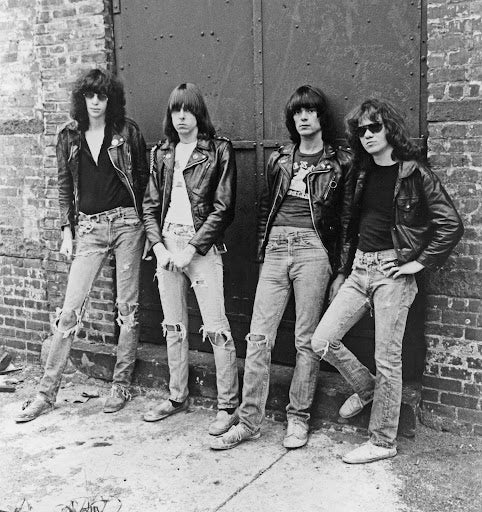
By the 1970s, the jacket had found one of its most important homes: punk. The Ramones made the black leather jacket virtually inseparable from the movement. Their look was simple and impossible to forget: leather jackets, T-shirts, ripped jeans, sneakers, long hair. Their 1974 CBGB-era uniform turned punk into something instantly recognizable. The Metropolitan Museum of Art notes that punk style, including studded leather motorcycle jackets, moved quickly from subculture into mass fashion.
This shift in who was wearing it matters too. In the 1970s, artists like Patti Smith, Joan Jett, Debbie Harry, and Suzi Quatro made leather feel less like a costume of masculinity and more like a language of confidence, performance, and refusal. The jacket's coolness was never about the material. It was about who got to look untouchable, and who got to take up space.

By the 1980s, the jacket had fully escaped its underground origins. Michael Jackson's red-and-black jacket in the 1983 "Thriller" video – designed by Deborah Nadoolman Landis – turned leather into a pop spectacle and created one of the most recognizable fashion moments in music video history. From there, it kept mutating. Bomber variations came back through film and pop culture. Punk leather entered designer collections. Long black leather coats became part of the futuristic 1990s aesthetic. Vintage and distressed versions became desirable because they looked like they had already lived a life.
The leather jacket has been absorbed so completely by the mainstream that it now hangs in mall windows, luxury boutiques and thrift stores. The same item that once carried genuine cultural panic is now a wardrobe staple. And yet it has never fully lost its edge, because it was never chasing anything to begin with. It has never needed to.

0 Comments
There are no comments yet. Be the first one to post one!