
Wartime Fashion of the 1940s by Ava DeLaOssa
Wartime Fashion of the 1940s by Ava DeLaOssa

The 1940s were one of the most dramatic moments in fashion of the last century. Women’s fashion was not about following trends, but about responding to a world war, strict government rationing, and an explosive desire for luxury once the war was finished.
The beginning of the decade was entirely defined by World War II. During the war, the government strictly rationed fabrics such as wool, silk, and leather, in order to prioritize military uniforms and parachutes. A regulation in the U.S. known as L-85 dictated just how much fabric would go into each item of clothing. Pleats, ruffles, and wide hems were banned in order to preserve fabric.

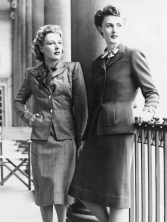
Because of these restrictions, a sophisticated yet minimal silhouette was created. Women’s clothing borrowed a lot of elements from menswear, creating an aesthetic that was practical and professional. The utility stuit became an everyday uniform for civilian women. It was made up of a boxy jacket with sharp, padded shoulders, and a straight pencil skirt. Because silk was unavailable, women got creative with their stockings. Women used leg makeup to simulate nylons, even drawing a straight line down the back of their legs to mimic seams. Women’s hair also changed due to factory jobs. Practical hairstyles came into fashion such as the Victory Roll. It keps women’s hair securely pinned up and out of the way when using heavy machinery.

When the war ended in 1945, rationing did not just instantly vanish. Women were exhausted by the years of drab colors and restricted fabric. Glamour was wanted back into the dull post-war world. IN 1947, Christian Dior launched his debut collection, which created a new look for women. Dior got rid of the idea of rationing. His designs featured dramatic round shoulders, a cinched waist, and large voluminous skirts. The hemline of women’s dresses also fell back to the mid-calf. In the beginning, the style was very controversial with some protesting the extravagance of using so much fabric while Europe was still rebuilding. The style ultimately won due to the craving for glamour and luxury.

By 1949, the sharp and masculine styles of the early 40s were completely replaced by a feminine hourglass figure. It was a decade of absolute extremes, proving that what we wear is not just about fabric, but it is a reflection of our cultural survival and wants of the future.

0 Comments
There are no comments yet. Be the first one to post one!