
Wearing the Smile: An Interview with Artist Kaili Godfrey By Georgia Stewart
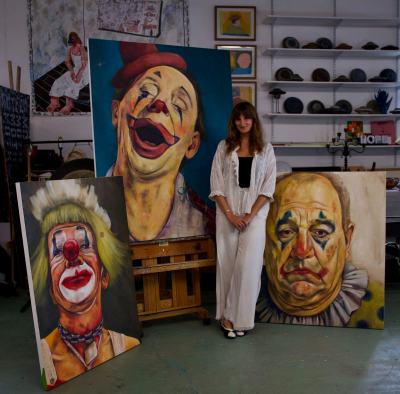
When I first viewed Kaili Godfrey’s clowns, I felt uneasy. A face that’s too close, a layered expression that doesn’t settle into one fixed emotion, and bright, splotchy color that somehow doesn’t feel bright at all. I was forced to sit in this uncomfortable ambiguity for a second. When we view portraits, we expect to see someone who is readable and maybe even recognizable. All we really know for sure is that they’re clowns, and everything else seems to be unstable and unfixed. Kaili Godfrey is a 24-year-old Southern California-based artist finishing up her clown series for her solo show, called The Burden of Performance. In this, Kaili is using her clowns to give a face to the performance of everyday life.

In After the Interlude (pictured below), we can see a contradiction between the layers of facial expression. The first layer is the one the clown portrays outwardly through makeup. The makeup is bright and fun, but still smudged and imperfect. The clown's smile is painted upward, yet the figure's real mouth does not match it. The layer slightly beneath this is the clown's actual face, which we can see only through the sad shadows and creases. There are deep wrinkles in his skin caused by years of wide smiles and expressive faces, but was any of that real?

Historically, a clown’s job was to perform joy and humor for others’ entertainment, and their entire identity was based on the audience’s response. When this performance doesn’t align with the performer's internal state, the job of being happy can become a burden. Kaili expressed that it seems like an impossible job to have to wake up and choose to be that version of yourself every day. Not only that, but clowns are figures who were laughed at, not with, showing that performance for the sake of others can be at the performer’s expense and involve a damaging level of self-distortion.
This imagery of clowns isn’t as distant as it may seem. As a recent college graduate, Kaili has been navigating the professional world while working a city job to support her art. She described the experience of having to cover tattoos for interviews and dress a specific way to appear professional, reliable, and intelligent. When she first entered the workforce, she lost time to create art and was sad to see herself distancing from her passions, feeling like she was playing a
role for a paycheck. Performance isn’t just theatrical; it has become routine in our lives, and this is the concept Kaili is addressing through her art.
Even outside of Kaili’s city job, Kaili has found herself performing in her art making. To Kaili, her art and process are very personal and vulnerable, but when she starts recording herself for a TikTok to market her work, even that authenticity becomes, to some extent, staged. The knowledge that she is being recorded for a public audience will influence Kaili to behave or present herself in specific ways, sometimes unconsciously. Like makeup as the physical mask for clowns, social media is a digital mask. Not to say that all social media is fake, but when a camera or an audience is involved, all social media brings some sort of performance.
When Kaili is constructing these layers of identity and expression, she begins with a chaotic underpainting. She then moves to a much more structured and calculated second layer, where she brings in the fine details. This tension between spontaneity and control mirrors the dichotomy between internal emotions and external presentation.

When Kaili was in school studying fine art, she found herself and others always trying to create beautiful, idealized figures that were pleasing to the eye. As she has grown into her style, she has enjoyed exploring something a bit more uncomfortable and confrontational. These clowns are large in scale and impossible to avoid. The viewer is almost forced to engage and interpret these works, maybe noticing their own reflection in them. Kaili has noticed that different people notice different expressions in the same clown, depending on their current situation. What makes this so unsettling is how easily this interpretation can turn back onto ourselves.
Performance is inherent and something we constantly navigate, not something we can always escape. In Kaili’s upcoming solo show, The Burden of Performance, she aims to be authentic by being open about being performative. With our digital lives becoming more and more equal to our physical lives, conversations about performance culture are ever more necessary, and Kaili is expressing and exposing this through exaggeration. But maybe it's not exactly exaggeration, and the only difference between clowns and the rest of us is just that their masks are visible.

https://www.instagram.com/kailigodfreyart/
By Georgia Stewart
7 Comments
Kaili you are an inspiration to us all. So proud of you. You truly are a 💫 star
An amazing artist and an amazing human being. Congratulations to Kaili on sharing her incredible talent
An amazing artist and an amazing human being. Congratulations to Kaili on sharing her incredible talent
Wow-what a great article and so eloquently describing the purpose and message of these works of art!
Truly awesome !
Truly awesome !
The most talented artist, ever. Her work is beyond magnificent. For such a young lady she has accomplished incredible artistic works of art that most people could not do in a lifetime. She is incredible!