
Fashion takes from stories rather than history itself By Harley Krata
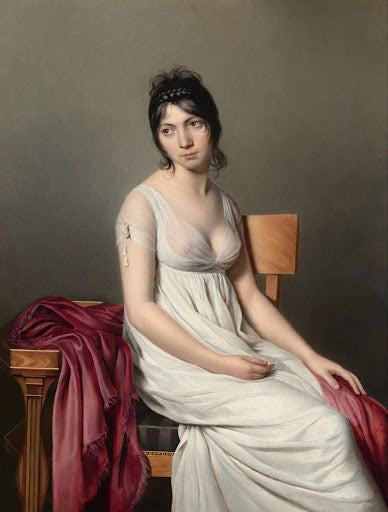

Before becoming a cult classic and appearing on Pinterest mood boards, Ottessa Moshfegh's My Year of Rest and Relaxation repurposed an image that already had a life of its own.
The cover of this novel features Jacques-Louis David’s Portrait of a Young Woman in White, an eighteenth-century painting depicting a woman in a dreamy white dress reclining on a wooden chair draped in red cloth. This painting is housed in the National Gallery of Art in Washington, DC. However, for many readers, myself included, this painting no longer belongs only to art history; rather, it also belongs to the main character in My Year of Rest and Relaxation.
Nowadays, many people don’t flock to clothing inspired solely by historical events; rather, they dress according to stories (bonus points if those stories are relevant to historical events). The readers who seemingly recreate the woman’s mood in the painting are not trying to replicate fashion trends from eighteenth-century France; they are trying to recreate the ambiance of Moshfegh’s main character. As I roam Central Park or I sit at my local Blank Street, I can’t help but notice how many people around me are not only reading My Year of Rest and Relaxation, but are morphing themselves into the cover image. They all seem to be wearing a loose white dress, blouse, or t-shirt, pale colors to complement it, neat but somewhat disheveled hair, and an almost stoic expression. These key elements have become a visual representation of the narrator's feelings discussed in the text: exhaustion, melancholy, privilege, isolation, boredom, and a desire to disappear. As a lover of this book myself, I even noticed a shift in my fashion choices while reading it. I put away my overly vibrant clothes and was drawn to the softer tones in my closet.
Somewhere between the canvas and the page, the Portrait of a Young Woman in White was no longer a painting, and was instead a character in this novel.
But I guess fashion has always somehow worked this way. We rarely dress like a historical period itself. Instead, we dress like the figures, characters, and stories that bring these periods to life. Ballet flats aren’t popular because everyone is a ballerina, but rather because they evoke a feeling that sneakers no longer give us. The things we decide to wear have less meaning than the stories attached to them.
The popularity of My Year of Rest and Relaxation shows how aesthetics are shaped by cultural synthesis. The painting of the woman came first, then the novel, then the readers, then the outfits and all that comes with that. Each of these layers helps keep every art form alive while also inspiring all types of viewers to develop their sense of style further. I think what makes this novel so alluring to younger generations is how the narrator rejects productivity and has little to no ambition in a society that seeks success and pressures those who don’t. The fashion inspired by this book helps to represent this contradiction. The clothing may seem effortless like the narrator, but we feel the pressure to be everything but that.
I often wonder if this is why specific images continue to loop throughout the fashion world. People are not only drawn to beautiful clothing or specific trends; they are drawn to the emotion these clothes evoke. Fashion is something that pertains to both the present and the past, but I think of it as more than that: images and stories. A painting inspires a novel; the novel inspires readers, and then a new aesthetic is born. Somewhere along the way, readers begin to dress less like eighteenth-century France and more like a feeling.

0 Comments
There are no comments yet. Be the first one to post one!