
Finding Your Niche as an Artist By Cecilia Wren
By Cecilia Wren
 As a senior in art college, I am often asked how I found out about what I am working on. I am primarily a sculptor, but I have tried everything from oil painting, to robotics, to plaster casting. I also have a lot of friends in the arts that are exploring mediums that are both similar and different from what I am working on. I’ve compiled some of the different ways that we have found what we are working on now for people trying to figure out how to find their niche.
1. Try Everything
Just like people say about vegetables, you never know until you try. When I first started art school I thought I wanted to go into printmaking. I couldn’t actually get into any of the printmaking classes so I ended up taking sculpture and falling in love with it. There are so many different mediums that you can try even just for a little while. I took a robotics in art class for one semester and enjoyed most of it, but it is not something that I plan on including in my artistic practice right now. The important thing is that I tried something and now I have the option to add more digital components to my work in the future.
If you are struggling to find something that you think will be your one true calling, start with one thing! You can always try something out for a little bit, take a class, and decide if that is what you want to do. One of the best things about being an artist is how you can try so many things and still be an artist.
2. Look at what inspires you
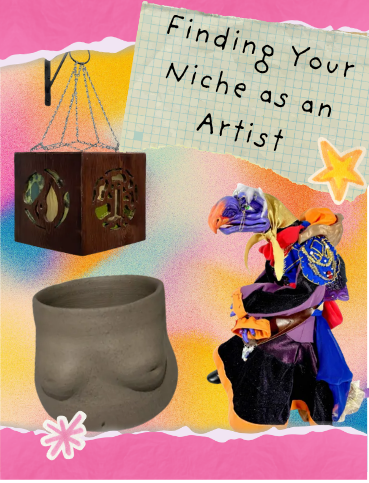
Robo is a friend of mine who has been working as an artist in connection with the Jim Henson Creature Shop for years. She originally started making fan art of The Dark Crystal, which led to making contact with artists from the Jim Henson studios. Robo has been integrating this practice into her printmaking making intaglio line etch prints, and continuing into her senior capstone exhibition. For this exhibition, she will be making a full scale puppet of her new character for the Dark Crystal, Skektel. When asked about this new character she said “I didn’t want to make an exact replica of an existing character. It’s more of a challenge to make something from nothing”. This project has been a long time in the making with six years of planning, drawing, and miniature versions. Robo is currently working on the preparatory work for the puppet and applying for grant funding.

Robo would never have gone down this path without following her inspiration from the Dark Crystal. You can find inspiration from anywhere! A lot of artists are successful from making fan art. Making art inspired by something else is the longest standing tradition in art. Technically, the famous renaissance artists made fan art of the Bible. You don’t even have to make art about other visual art. Many artists are inspired by music, poetry, stories, myth, the sky is the limit.
3. Combine your passions
Many beginner artists think that you have to only pick one track when it comes to art careers, but there are so many options for combining all of your passions. Danyale Patterson is an Art Education student with an interest in ceramics. One may not think that they combine together, but she has aspirations of running a high school ceramics program to inspire the next generation of potters. Part of this dream is not only being an educator, but a practicing artist herself. To work towards this goal, she has been working on an exhibition for this fall exploring the relation between ceramic vessels and the body.

Education and art are not the only practices that combine together, many artists combine science and art. One of the artists on the forefront of this is Geo Rutherford, a content creator, science educator, and artist. Rutherford writes and illustrates books about the history and science behind spooky lakes and rivers. If you are passionate about art and science, they combine naturally.
4. Don’t box yourself in
When you find what you are interested in, don’t expect to stay there forever. There can be changes that you can’t control that force you to do something else. One of the major changes that I faced as an artist was pivoting after my school shut down our foundry due to safety issues. I tried the process of cold casting faux bronze sculptures, but after some experimentation I realized how much I enjoy the process of woodworking and stained glass. Without that happening, I would have never had my idea for my senior capstone.

Another friend of mine, Travis Sullivan, started college thinking he wanted to go into game design, but slowly came to realize that he wanted to be a studio artist. Part of this came from taking many different art classes and realizing his strengths are more in the physical medium rather than digital. He has been working on ways to combine the two together into his practice going forward.
There are so many ways to be an artist, and limiting yourself to one medium can be harmful to your practice. Letting yourself learn and grow through exploration and changing your mind is part of being an artist, so give yourself some grace and time to experiment.
0 Comments
There are no comments yet. Be the first one to post one!