
The Evolution of Edwardian Fashion from 1900-1909 by Ava DeLaOssa
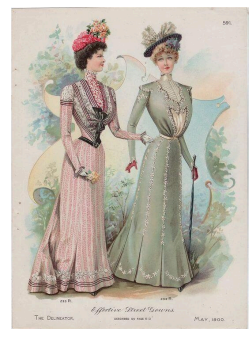

The first decade of the twentieth century was a golden age for luxury and refinement, accompanied by a drastic societal transition. The Edwardian era (1900-1910) was named after King Edward VII of Great Britain and represented the high fashion of the aristocracy just before the First World War. This decade of fashion was defined by its dramatic silhouettes, luxurious fabrics, and refined etiquette that dictated different garments for each hour of the day.
At the beginning of the decade, women’s fashion was dominated by the “S-bend” and or “pigeon-breast” silhouette. This distinctive look was achieved through a highly restrictive corset. Unlike Victorian corsets that compressed the waist evenly, the Edwardian corset forced the posture forward at the bust, while pushing the hips backward, creating an exaggerated “S” shape. The bodices were also heavily embellished with lace, ruffles, and high boned collars that reached all the way to the jaw.

The “Gibson Girl” look was popularized by the illustrations of Charles Dana Gibson, which became the ideal vision of feminine beauty. The Gibson Girl was tall, athletic, and independent. The signature look consisted of a white
blouse known as a shirtwaist paired with a dark, tailored skirt. The ensemble was practical and allowed women greater freedom of movement, and reflected their growing presence in the workforce and universities.

As the decade progressed into its later years, the rigid S-bend silhouette began to soften. Around 1908, the French designer Paul Poiret introduced the “Directoire” style, using inspiration from the late 18th century and ancient Greece. This new style created the empire waistline, which sat high, just under the bust, allowing for dresses to fall in a straight, narrow column to the floor.
The high collars went away and was replaced by softer v-necks, and corsets started to be replaced by more fluid and modern garments.
During the Edwardian era, hats were quite a big deal. Early in the decade, hats were modest, but by 1908, they turned into large and oversized “Merry Widow” hats. They were covered in elaborate arrangements of silk flowers, tulle, lace, and exotic bird feathers. These hats required long, sharp hatpins in order to stay anchored to women’s voluminous “Pompadour” hairstyles.

The fashion of 1900 to 1909 stands as a bridge between the two worlds. It celebrated the final peaks of nineteenth-century extravagance while taking in comfort, practicality, and liberation that would completely redefine the modern wardrobe in the decades to follow.
By Ava DeLaOssa

0 Comments
There are no comments yet. Be the first one to post one!