
All About Reliquaries By Cecilia Wren
By Cecilia Wren

What is a Reliquary?
Reliquaries are a sculptural rite of passage, they have been integrated into sculptural practice dating back to before the Renaissance. Sculpture students today are still encouraged to create reliquaries to hold objects of great importance to them. Contemporary sculptors influenced by Catholicism often turn to reliquaries to convey their feelings about the institution of the church. Reliquaries have always been an important part of sculptural history. Traditional reliquaries hold objects of importance to the church, they act as a preservation system for these fragile artifacts. Modern reliquaries can differ in their goal. Modern reliquaries are less constrictive in form than historical ones, but they carry the same numen (Neumen: a spiritual force or influence often identified with a natural object, phenomenon, or place (Merriam-Webster))

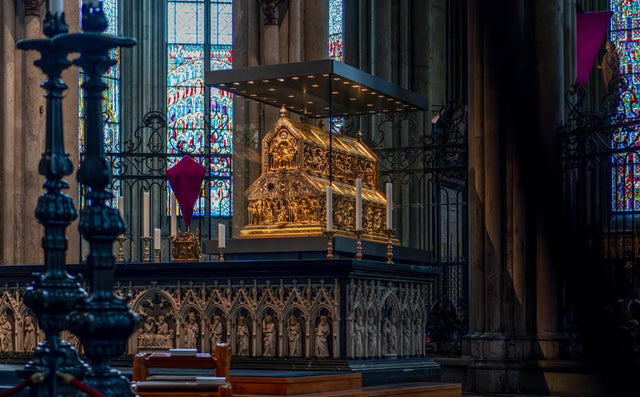
Right to left: Shrine of Three Kings (1190-1220) housed in the Cologne Cathedral, Reliquary for the Severed Head of Saint Catherine of Siena (1347-1380) housed in the Basilica San Domenico, Holy Face of Manoppello housed in the Church of the Volto Santo di Manoppello
First you have to know what a reliquary is. Reliquaries are containers for objects of religious importance. These objects are usually artifacts that saints or religious figures had close contact with or their remains. The most memorable type of reliquary are those that contain human remains, they are the most sought after and have been around the longest. The job of the reliquary is to contain the relic inside and protect it from external factors. Early reliquaries were modeled after caskets or religious architecture; they eventually turned more sculptural in nature (Ginsberg, 2023). Casket reliquaries like the Shrine of Three Kings (fig. 1) , housed in the Cologne Cathedral, are highly ornate and do not allow for the viewing of the remains of those entombed inside (Kolner Dom, 2026). Many reliquaries do have windows that allow the viewers to see the relic. In the Basilica San Dominico in Siena is the mummified severed head of Saint Catherine of Siena (fig. 2). This relic is viewable at all times to the public (Thuras, 2010) where they can worship and be blessed by the saint. An important part of traditional reliquaries is the relic inside. To have a relic recognized by the Vatican, it must be from a venerated saint and perform miracles even after the death of the saint. There are many unconfirmed relics, even some well known ones like the Holy Face of Monappello (fig. 3) are unconfirmed (Harewood, 2023). The power of these unconfirmed relics does not come from the acceptance from the Catholic church, but from the belief and devotion of the visitors, much like the reliquaries made by contemporary artists today.

Right to left: Untitled (Meat Piece with Chair) Paul Thek (1966) wax, bronze, Formica, Plexiglas, 16 1⁄2 × 21 1⁄2 × 9 1⁄2" from the series Technological Reliquaries, Untitled Paul Thek (1966) Wax, paint, polymer resin, nylon monofilament, wire, plaster, plywood, melamine laminate, rhodium-plated bronze, and acrylic 14 × 15 1/16 × 7 1/2 in. from the series Technological Reliquaries
Contemporary artists often attempt to capture the preservation of bodily artifacts of saints. One artist that does that effectively is Paul Thek. Post-humously named Technological Reliquaries these Untitled Meat Pieces look like preserved forms of bug human hybrids. Using wax, pigments, and hair Thek is able to craft hyperrealistic limbs that are entombed within plexiglass and formica. Thek was directly inspired by the Capuchin Catacombs in Italy and the bodies that he saw. “There are 8,000 corpses—not skeletons, corpses, decorating the walls, and the corridors are filled with windowed coffins,” (Wyma, 2021) Thek said in an interview about his experience. Seeing death and decay brought him to the idea of preserving these pieces to the gallery spaces. These pieces focus more on the object inside rather than the container itself. Contrasting the historical reliquary the Shrine of Three Kings, Thek’s Technological Reliquaries are simplistic on the outside. If the materials for the container were not listed in the materials list, one could assume that it was built by the gallery exhibiting it. The viewing windows are made of plexiglass, sometimes in neon colors distorting the color of the piece of meat inside into sickly inhuman tones (fig. 4). The base of the reliquary is made of formica, a kind of composite wood board, a sharp contrast from the gilded historical reliquaries. The simplicity of the reliquary and its focus as just a container for preservation allows the relic inside to stand out even more. Looking at Untitled (Meat Piece with Chair) (fig. 5) the viewer can truly spend time focusing on the intricate details of the wax limb rather than the container holding it inside. Even though Thek’s Technological Reliquaries are unlike some historical reliquaries, they still carry the same thoughts, preservation of the dead.

Heart of Saint Camillus Reliquary (1614)
Many historical reliquaries hold similar bodily objects like Thek’s technological reliquaries do. While many reliquaries preserve the bones or objects that the saint’s blood touched, the Heart of Saint Camillus (fig. 6) is special. After St. Camillus died, an autopsy was performed and his heart was removed and enshrined (Communications Office of Camilliani, 2016). While St. Camillus was an important figure in the church, known for starting an order of priests known for healing the sick. After death, the heart is still performing miracles much like St. Camillus did in life (Jill of Alltrades, 2013), performing one of the requirements to become an official relic of the Catholic church. The reliquary itself is as interesting as the story, containing several parts allowing people to be at different differences for viewing and connecting with the relic. The heart is inside a heart shaped glass casket, which is nested inside of a larger dome shaped reliquary. This nesting doll of a reliquary is then put inside a larger glass case that rests on a litter carried by two people. The many different cases are used to protect the relic itself as it has been preserved since the saint’s death in 1614 (Communications Office of Camilliani, 2016). The Camillian order shares the details of the relic on their website stating that the inner dome shape is inspired by the Roman sacellum ( Sacellum: an unroofed space in an ancient Roman building consecrated to a divinity (Merriam-Webster)), allowing viewers to behold the relic from multiple angles (2016). The innermost heart casket is held up by two angels, an ornate detail that is typical of many reliquaries. While the outside of the reliquary differs from Paul Thek’s Technological Reliquaries, the content inside has a similar numen. The Technological Reliquaries are forever preserved as they are made of wax, but the viewer is able to imagine a future where they have a similar fate as the Heart of St. Camillus.

The Spine and Tooth of Santo Guerrero Al Farrow (2007) Steel, Brass, Gold, Bone, Fabric, Tooth, 64 x 50 1/2 x 74 in
Thek broke the mold of what a reliquary is supposed to look like, but many other artists embrace the historical forms with open arms. Al Farrow is one of the artists inspired by the historic forms and church architecture that historical reliquaries often take the form of. Recreating not just traditional Catholic architecture, Farrow explores themes of religious violence, persecution, and modern crusades by recreating synagogues, mosques and churches entirely out of guns and ammunition (de Young, 2026). Another unique quality about Farrow’s work besides his materials, is his invention of a saint. Farrow invented Santo Guerrero, a saint of warfare and gun, to entomb in his reliquaries. One of the pieces that best showcases Farrow’s work is The Spine and Tooth of Santo Guerrero. The piece is a scale replica of an unspecified gothic cathedral, housing a real human spine. Farrow’s choice to use real bone allows for there to be even more of a numen around the objects. Farrow already captures the grandeur and awe that churches and historical reliquaries use, but also using real human bone allows for the same feeling of a soul within the piece as historical reliquaries. While a large portion of the structure of the piece is historically inspired, the use of unique materials pushes Farrow’s reliquaries even further. Choosing to use weapons that enact violence against humanity to preserve the body of a fabricated saint gives the work an ever deeper meaning than something made of bronze or wood (Farrow). Farrow showcases the violence of churches and how they use religion and saints to hide their violence through his reliquaries.

New Reliquary for the Crown of Thorns (2024) in Notre Dame Cathedral, Paris
Farrow is inspired by gothic and roman architecture that historical reliquaries take their design inspiration from, but some historical reliquaries have unique shapes. One of these unique reliquary designs is the Crown of Thorns, housed in Notre Dame. This relic is said to the crown of thorns placed upon Jesus’s head at the crucifixion. The relic was found by Saint Helena in the late fourth century, and then transported to France by King Louis IX in 1239 due to political turmoil in Constantinople where it was previously housed (Delattre). The shape of the reliquary and how it differs from other reliquaries in shape/construction. The reliquary is circular and carried on a plush velvet pillow. The crown only comes out on Easter. Encircling gold around a glass case. The crown is not able to be removed from the reliquary. This relic is also debated to be real, since it is so old and it is hard to know if the real crown of thorns can actually be preserved. More focus on the content of the relic than the construction of the outside. The original reliquary was most likely made by a goldsmith during Napoleonic times, as that was when it was permanently moved to the Notre Dame Cathedral. The 2019 fire in Notre Dame changed some things for the relic.
When the Crown of Thorns was rescued from the fire, the glass case it was stored in was broken. During the restoration of the cathedral, there were plans submitted to reconstruct the reliquary by architect and designer Sylvain Dubuisson (A New Reliquary for the Crown of Thorns - Revivre Notre-Dame, 2022). The new reliquary is a large golden halo surrounding the crown of thorns, embedded in royal blue velvet. The new reliquary is more open to the public than the previous, allowing people to view it more times than the holy days. The reliquary is heavily byzantine inspired with the large golden halo reminiscent of Duccio’s, Rucellai Madonna heavily gilded painting from 1285 (Le Gallerie Degli Uffizi). This modern reliquary that takes heavy inspiration from historical paintings makes the Crown of Thorns even more unique.
Reliquaries come in all different forms, but the most defining aspect is the time period that they were produced. Many reliquaries that are more recent take inspiration from historic architecture and paintings, however some break that mold. Paul Thek is one of the contemporary artists that create reliquaries that stand out being more inspired by the relic inside rather than the container itself. Most other artists, however, find the reliquary as a container the fascinating aspect. Artists like Al Farrow draw their inspiration from the reliquary, keeping with the tradition of architecture inspired pieces. Even with vast differences of historical and contemporary reliquaries, they still have the same power of belief within them. If you truly believe that an object can have the power to heal and perform miracles, it does not matter if it is from a saint or created by an artist.
References
A new reliquary for the Crown of Thorns - Revivre Notre-Dame. (2022, March 3). Revivre Notre-Dame. https://revivre-notre-dame.fr/en/projet/new-reliquary-for-the-crown-of-thorns/
Bhatia, V. (2017, August 6). Tracing the evolution of art with the Virgin and Child. Medium. https://medium.com/@Vaidehi_B/tracing-the-evolution-of-art-with-the-virgin-and-child-4df410283e4b
Boehm, B. D. (2001, October). Relics and Reliquaries in Medieval Christianity. Metmuseum.org. https://www.metmuseum.org/essays/relics-and-reliquaries-in-medieval-christianity
Communications Office of Camilliani. (2016, May 27). The Relic of the Heart of Camillus | Ministers of the Sick. Ministri Degli Infermi Religiosi Camilliani. https://www.camilliani.org/en/the-relic-of-the-heart-of-saint-camillus-a-part-of-the-greatest-story-ever-told/
de Young. (2026, May 3). In the Name of God: War, Religion, and the Reliquaries of Al Farrow. Fine Arts Museums of San Fancisco. https://www.famsf.org/exhibitions/name-god-war-religion-and-reliquaries-al-farrow
Delattre, L. (2025, January 6). Veneration of the Holy Crown of Thorns - Notre-Dame de Paris. Notre-Dame de Paris. https://www.notredamedeparis.fr/en/veneration-crown-of-thorns/
Farrow, A. (2025, February 20). Complete Synopsis of Work. Yuma Art Symposium.
Ginsberg, S. (2023, September 14). All You Need to About Reliquaries: Meaning, History, Examples and More. Titan Casket. https://titancasket.com/blogs/funeral-guides-and-more/all-you-need-to-about-reliquaries-meaning-history-examples-and-more?srsltid=AfmBOoob-F7365RBmo2g5hAJbgmcKFboNbFO2CRtsPVdScge6gpl51cg
Harewood, D. (Director). (2023, November). Mysteries of The Faith. Netflix.
Jill of Alltrades. (2013, March 13). Close Encounter of the Relic Kind - St. Camillus’ Heart Relic. HubPages. https://discover.hubpages.com/religion-philosophy/Encounter-with-a-Heart-that-Goes-On-a-Journey
Kolner Dom. (2026). Kölner Dom | The shrine of the Magi. Koelner-Dom.de. https://www.koelner-dom.de/en/tour/cologne-cathedral-and-the-jews/the-shrine-of-the-magi
Le Gallerie Degli Uffizi. (2024, April 3). Virgin and Child enthroned, surrounded by angels (known as the Rucellai Madonna). Uffizi Galleries. https://www.uffizi.it/en/artworks/virgin-and-child-enthroned-surrounded-by-angels-known-as-the-rucellai-madonna
Matthew Marks Gallery. (2018). Robert Gober . Matthew Marks Gallery. https://matthewmarks.com/artists/robert-gober
Merriam-Webster. (2026a). Numen defintion. Merriam-Webster.com. https://www.merriam-webster.com/dictionary/numen
Merriam-Webster. (2026b). Sacellum Definition. Merriam-Webster.com. https://www.merriam-webster.com/dictionary/sacellum
Stevenson, R. (2011, July). Al Farrow’s Modern-Day Reliquaries - Sculpture. Sculpture. https://sculpturemagazine.art/al-farrows-modern-day-reliquaries/
Thuras, D. (2010, May 12). St. Catherine of Siena’s Severed Head. Atlas Obscura. https://www.atlasobscura.com/places/st-dominics-basilica
Venkatasubban, S. (2017). Carnegie Magazine | Spring 2011 | Reclaiming Paul Thek - By Sharmila Venkatasubban. Carnegiemuseums.org. https://carnegiemuseums.org/magazine-archive/2011/spring/feature-243.html
Whitney Museum of American Art. (2025). Untitled from the series Technological Reliquaries. Whitney.org. https://whitney.org/collection/works/8323
Wyma, C. (2021, December). Paul Thek. Artforum. https://www.artforum.com/events/paul-thek-11-249167/

0 Comments
There are no comments yet. Be the first one to post one!