
Who Gets In By Julia Vilardi
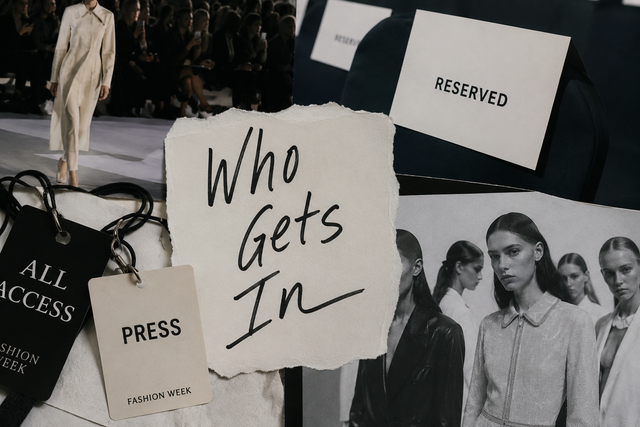

There’s a growing tension in fashion that’s hard to ignore, and you can see it most clearly not on the runway, but at the door. At the recent Rio Fashion Week, the conversation wasn’t just about the collections, but about access. Who was invited, who wasn’t, and how those decisions are being made. Influencers filled seats that, not long ago, might have gone to stylists, editors, or young designers who spent years studying and working toward that exact moment. It’s not simply a matter of preference or taste. It reflects a broader shift in what the industry values and rewards.
Audience has become leverage, and visibility has become its own kind of qualification. Influencers understand that system instinctively. They don’t just attend shows, they extend them, turning looks into images and moments that travel far beyond the room. A collection doesn’t stop at the runway anymore. It continues online, reaching people who were never meant to be there in the first place. From a business perspective, it makes sense. Reach is immediate, measurable, and hard to ignore.
But there’s something more complicated underneath it. For a long time, access meant process. It meant time, learning, assisting, being close to the craft before being centered in it. Now that path can be skipped. The door still opens, but not always for the same reasons, and that shift doesn’t go unnoticed.
This isn’t really about whether influencers should be there. They are part of the industry now, and they shape it in real ways. The question is what happens when being seen starts to matter more than making, and whether there’s still space for both without one quietly pushing the other aside.
0 Comments
There are no comments yet. Be the first one to post one!