
Daniel Tagbo's "Almost" Explores Mythology, Ambition & Creative Resilience By Georgia Stewart
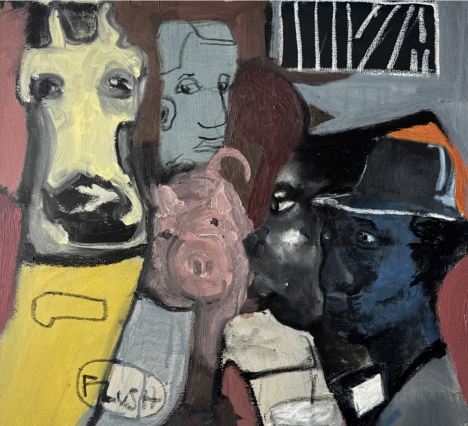
Daniel Tagbo is a 23-year-old New York City-based artist, originally from Missouri. Tagbo moved to New York for college, where he planned to pursue music, but ended up majoring in fashion design with a minor in fine arts. Throughout his life, Tagbo has always been a creative person, gaining experience in almost every creative discipline, with a relatively recent, dedicated focus on painting. His journey has been defined by exploring different creative ambitions rather than following a singular linear path.
After graduating from college, Tagbo found it difficult to find a desirable job in fashion as he had planned, so he turned his focus back to painting. At this time, he tried to work through the emotions of having a dream not work out, and he has been communicating his thoughts on that subject in his current collection, ‘Almost’. The foundation of this collection is his experience of being close to something but not quite there yet. Creative careers rarely have a clear finish line, and every achievement often reveals another goal behind it. Tagbo is expressing a sense of creative discontent, a feeling familiar to many other creatives who spend years chasing something that lacks a clear endpoint. In ‘Almost,’ Tagbo’s personal experience becomes a lens through which he examines broader concepts.

Daniel Tagbo, Welcome to the Jungle, 2026
When viewing the artworks in ‘Almost’, one of the first things viewers notice is the expressions, and more notably, the eyes. The faces may initially appear shocked, sad, or scared, but on closer analysis, they look less like immediate reactions and more like something the figure has been carrying for a long time. They seem exhausted and weary, but their eyes look at something
beyond the canvas. The ambiguity of this gaze leaves us wondering whether they are looking at something harmful or perhaps at the light at the end of the tunnel. And if this is the desired destination, it remains unclear whether that light is within reach. This is the core of ‘Almost’. The figures occupy a space between doubt and belief. Here, exhaustion and hope can coexist.

Daniel Tagbo, Something’s Missing, 2026
In ‘Almost’, Tagbo has taken a huge interest in mythology, as myths have historically been used to explain human experience and desire. Tagbo frequently draws on mythology, using the Minotaur as a metaphor for obstacles encountered in the pursuit of success and fulfillment. When speaking with Tagbo, he referred to the American Dream as a contemporary myth, describing how modern society continues to organize itself around narratives of success, freedom, and fulfillment, even though that may not be attainable for everyone, or even most people. In works like Promised Land, promises themselves become important symbols throughout the collection, relating to promised futures and unattainable destinations.

Daniel Tagbo, Promised Land, May 2026
“Endless war, for the sake of unattainable freedom.”
Mythology and animal symbolism serve a similar purpose in this collection. In Bull Fight 1, the bull acts almost as a mirror or shadow of the human depicted. The animal functions as an externalized emotion rather than as a separate creature. Animal symbolism is used all throughout the collection to personify aspects of human psychology and behavior. Through this animal symbolism and the connection to mythology, Tagbo creates a space where we can observe human behavior and the systems we inhabit from a distance, outside everyday life. This distance allows viewers to see these behaviors and systems from a different angle and notice patterns that might otherwise go unnoticed.

Daniel Tagbo, Bull Fight 1, May 2026
“Impulsive anger, personified as a raging bull.”
Throughout our interview, we discussed many examples of human violence and injustice in American society that are often overlooked. Tagbo explained that many violent stories in mythology or history may be seen as barbaric, or as if the humans in these stories are distant relatives of the humans today. However, even today, some of these behaviors continue, just taking on a different form. Works like Animal Farm force us to question how far away humans really are from the way they are depicted in these ancient and mythological stories. Tagbo explained how, in contemporary life, we may have new technological advancements and a more civilized way of living, but the same violent human impulses and human tendency to “want to see blood” persist. By using allegory, Tagbo makes these seemingly complex subjects and situations easier to examine.

Daniel Tagbo, Animal Farm, June 2026
“A reflection on animal agriculture and sacrifice.”
While one angle of this collection discusses the more violent side of human nature, it also reveals a hopeful side. The same human nature that produces violence, injustice, and hardship also produces undying resilience and optimism. The eyes of the figures in Tagbo’s work still have a glimmer of hope. They look beyond the canvas, perhaps at another obstacle, or perhaps at the outcome they have been searching for. This collection is not about the arrival at an end goal; it is about the pursuit and resilience it takes to get there. What makes these figures so compelling and moving is not that they have found what they seek, but that they continue to push forward despite the many obstacles they face along the way.

Daniel Tagbo, Jail Break, 2026
See more of Daniel Tagbo on his social media and website.
Instagram: https://www.instagram.com/danieltagbo/
TikTok: https://www.tiktok.com/@probablydaniel.mp3?_r=1&_t=ZP-97LRbPU1E5u Website: https://danieltagbo.com/
0 Comments
There are no comments yet. Be the first one to post one!