
How Rothko inspired our wardrobes By: Harley Krata
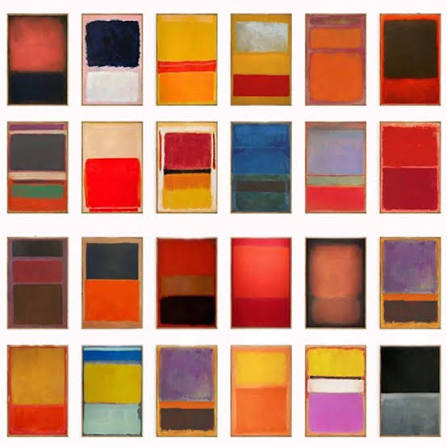

Whenever I find myself at MoMA, among Mark Rothko’s masterpieces, I am instantly taken in by the whispers around me. Rothko was an American painter who helped to develop Color Field Painting during the Abstract Expressionist movement. Other viewers sit on benches attempting to replicate his work; others sit in silence observing the works in front of them; and many others sigh in disbelief that such a “simple” work of art would be recognized in a museum.
What’s so moving about this? A woman with two children mutters to her youngest.
But I guess if you know nothing about Rothko, many of his paintings just look like rectangles and colors.
Rothko liked to paint feelings, another woman with a sketchpad responded, and I couldn’t agree more.
Rothko is not asking his viewers to study only the objects in the paintings, but rather to reach deeper and experience the emotions of the piece(s). The colors do more than just sit next to each other; they are brought to life in a way that forces us to confront our emotions, the feelings that are hard to describe but can’t be ignored. To me, fashion uses this same method to ask the same question: can a color tell a story on its own?
Many of us think about the silhouette when deciding what to wear. Is this shirt too fitted? Is this skirt full enough? Does this blazer shape me right? Social media has conditioned us to focus on the garment's fit before its color, but fit is only half the story. Before even studying the silhouette, we notice the color when the item is hung on a hanger or folded in a drawer. Color is the first thing that stimulates our emotions. On a sunny, warm day, I gravitate more towards the pastels in my closet; however, in the rain or on cold days, I lean more towards olive greens, blacks, and navies. The style of clothing hasn't changed, but the color has.
Rothko understood that colors rarely exist alone. Their meaning is based upon mood, attitude, and feeling. Color is subjective. And because of this, fashion works in the same way. Many designers don’t choose colors just because they are “on trend”; instead, they build a relationship around that color. A mood is created long before the piece becomes ready-to-wear. Luxury fashion favors feelings. Yes, every item may be perfectly tailored and clean, but it’s the atmosphere surrounding the piece that makes it meaningful. The color palette lets the clothing come to life. And maybe this is why colors always make a return once they’ve become “forgotten.”
Every season, trend reports tell us which colors will be “in” next season, but we never stop to wonder why this color has a reassuring effect. Yes, we wear colors because we like them, but we also wear them because they make us feel a certain way; they help us project the versions of ourselves that we want the world to see. Fashion is a language, and color is the key to the dialect. Rothko believed that colors could express emotions in ways that words couldn’t. And more than half a century later, fashion continues to prove this point. This is why we return to specific colors, even if they fall “out of trend.” We constantly search for ways to express how we feel, who we are, and how we want to express ourselves.
I like to think of Rothko's “basic rectangles” like this: every morning, when I wake up and enter my closet, I am doing something similar to what Rothko did. I choose my outfit not only for how it looks on me, but for how it will make me feel. This is the power of fashion, art, and color. Before our clothing tells the world who we are, we rely on color to do our storytelling.
https://www.moma.org/artists/5047-mark-rothko
0 Comments
There are no comments yet. Be the first one to post one!