
Kostumes of Kombat: The Brutality of Evolution in Mortal Kombat’s Female Character Design by Indigo Mapa
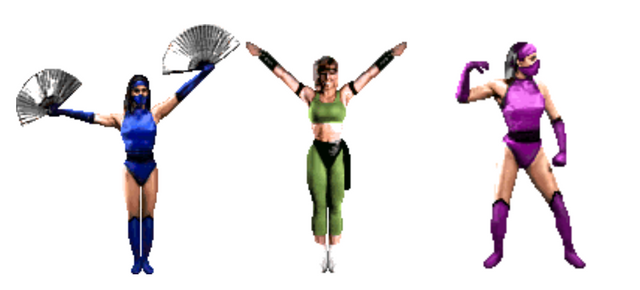

I truly wish I could remember the details of my first impression of Mortal Kombat, because I cannot recall which game it was (I want to say it was around the era of Deadly Alliance, Deception, or Armageddon) that caught my attention. What I do know is that one character stood out to me. She stayed consistent on my radar because of her unique character design: the magenta bodysuit, the black hair, the sharp gaze. But what truly got me hooked was when she took off her face mask. The tragedy of it all, existing as a clone of an Edenian princess mixed with the blood of a Tarkatan, spoke to me. Unsure if it was attraction or discomfort, my curiosity for Mileena became a fixation that has grown into a love for NetherRealm’s beloved franchise.
Though I can prattle on about how much I love Mileena, her backstory, and her moveset, I want to shift the focus to what our esteemed women kombatants are wearing. There has been an ongoing conversation on the evolution of the female character designs in this series. It fascinates me how much has developed with the game, and I want in on the topic.

The Mortal Kombat franchise has shifted visually and stylistically since its debut in 1992, precisely in the design of its female characters. Across the vast number of installments, the outfits have progressed in aspects that reflect the advancement of technology, artistic direction, and the bigger picture of the gaming industry. Character presentation has changed over the years, starting with digitized actors and moving to 3D character models. These changes have been the pinnacle of how technical processing and artistic choices have taken place in such a well-loved game.
Early entries of Mortal Kombat, such as the arcade game, character designs were made using digitized images of real actors. The actors were filmed in specific costumes, then their movements were interpreted into in-game sprites. This, unfortunately, made outfit choices for all characters very limited. The outfits had to be practical, visually simple, and recognizable. If I can recall, the sprites had all the same costumes, just different color palettes. Sub-Zero, Scorpion, and Reptile are prime examples of this.

In Mortal Kombat II (1993), more characters were added, such as Kitana, Mileena, and Jade (who was a hidden character). These characters shared a common costume, the only variation being color changes. The outfits were revealing, offering minimal coverage with the leotards and form-fitting silhouettes. This made them easier to animate and visually distinguishable within the hard limits of arcade hardware. Critics and players alike interpreted these character designs as emphasizing physical features and physical appeal, while others see them as consistent with what technology had to offer at the time for early fighting games.

As the franchise began to transition into the 3D era of video games, releasing titles such as Mortal Kombat: Deadly Alliance (2002) and Mortal Kombat: Deception (2004), the design process began involving fully modeled 3D characters. This development created a flexible space for costume design where outfits no longer needed to adhere to a live-action shoot. During this time, characters like Kitana, Mileena, and Sonya Blade were given more personality and individuality. This incorporated various fabrics and accessories, and for Sonya, more military elements that emphasize her role in the narrative.

A notable and distinct release in the Mortal Kombat franchise, Mortal Kombat (2011), also known as MK9, is something I want to focus a little bit on. MK9, to my surprise and lack of prior knowledge, is considered a 2.5D game, where 3D graphics are played on a 2D plane. This gave the game an iconic look, in my opinion. But when I saw Mileena wearing nothing but a BANDAGE? I found it laughable.

The women in this specific game were depicted in outfits that are highly revealing, form-fitting, and shocking to some people. Their high-definition textures helped resemble the Klassic looks they had in previous games, emphasizing less on any practical combat wear. This opened up a debate on whether this was an issue with sexualizing the characters or was simply a part of what Mortal Kombat stood for. On the one hand, people found these outfits to be in poor taste and outdated in terms of approaching female character representation. On the other hand, people argued that it was in line with the whole franchise’s message to fight censorship. This conversation became a part of a shift in how people discussed standards in character design during the early 2010s.

Personally, as much as I find MK9 iconic for its revitalization of the franchise, I had qualms with how many fans and players of the game use it as a reference on HOW THE WOMEN SHOULD BE DESIGNED in later games. I don’t mind the women in my video games being sexy and wearing insanely designed outfits (I’m a fashion over function person), but it’s amazing how many players got ruffled over later designs because Kitana, Jade, Mileena, Sonya, and Skarlet weren’t in monokinis and thigh-high heels. It’s gotten to the point where someone started a petition to bring back MK9-style character designs in Mortal Kombat 11. This line in particular got a chuckle out of me and a beautifully (and hilariously blunt) written piece by Kiesha Richardson: “Why do the male characters in Mortal Kombat 11 run around shirtless and even half-naked while female characters are decked out head-to-toe?” I found this just as laughable as the Mileena bandage skin, because clearly our views of sexualization are completely different. Sexualization isn’t just about clothing. It goes deeper than what one wears, but into how one behaves or perceives things or people, etc. Mortal Kombat has proven itself not to be geared towards women or the female gaze, but is clearly trying to cater to a different demographic now. Complaining that the “babes in thongs” aren’t apparent in later games as a main serving point clearly expresses that this person had a different set of priorities. The portrayal of women in Mortal Kombat has changed. As Richardson says, “They’ve grown. And so, too, have their costumes.”
Shifting the focus to later games such as Mortal Kombat X (2015) and Mortal Kombat 11 (2019), the redesign is more than apparent. Graphics have advanced tremendously, making room for highly detailed character models. Kitana and Jade are given complex garments that include protection and armor, and culturally influenced details. My Mileena? Her design became
reflective of her hybrid identity and blended pieces of earlier styles with more elaboration. Additionally, the recent designs became more attuned to the character stories and origins. Kitana and Jade, who are Edenians, wear ornamental accessories, flowing fabrics, and motifs that suggest royalty. These add to the world that has been built so carefully, giving each character more of a distinct sense of identity.

There’s a Reddit thread from five years ago that speaks directly to Mortal Kombat players, and I believe it’s an interesting read for those who are curious about what others think of how women have been portrayed in this game. I want to end this on a note where my piece sparks a conversation. I believe that change is not only great, but necessary. Video games are timeless, and I believe Mortal Kombat is one of those timeless games that will leave an indelible mark. But to keep going, you must adapt. I love that the newer games have brought back the Klassic outfits for those to use on the characters. I also love that everyone has such a distinct look now. Sure, some of the outfits don’t make sense (i.e., Skarlet) canonically, or some of them are too busy… But I believe a balance is being made, or there is an attempt at doing so. I believe having a choice is what actually matters. People should be able to choose what their characters wear; they should be able to feel as if they’re immersed or connected to a certain level with the game for them to truly enjoy it. As for the debate that violence is overlooked and accepted but sexualization is a big no-no, I think we’re all still figuring out how to navigate what’s truly important to each of us. This includes me, because my favorite character is one of the, if not the most, sexualized characters in the entire franchise. I don’t think there will ever be a consensus, especially anytime soon. Perhaps, there might not be a need for one. It’s easy to get lost in a world of opinions and forget the importance of your own. There are give-and-takes, even in something like a video game. What I do think is that you’re entitled to feeling anything you do when consuming ANY piece of media. I also think that it’s completely up to you to make it “deep” or not care at all, because at the end of the day, it’s your life and you get to decide how you enjoy something.
by Indigo Mapa

0 Comments
There are no comments yet. Be the first one to post one!