
Who am I without an aesthetic? By Veronique Lhuillier
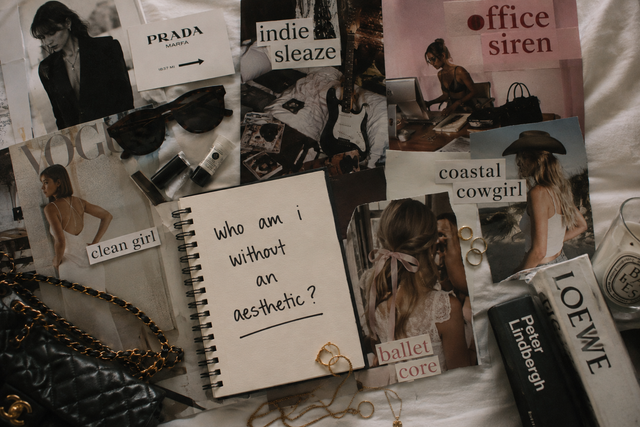
Yesterday, I woke up and wanted to be the clean girl. I put on a white cardigan, a long silk skirt, and ballet flats. I slicked my hair back into a neat French twist and sat at a coffee shop to read.
Today, I felt more like the cool girl. I put on a pair of low-waisted baggy jeans and a blousy maroon top that slid off one shoulder. My wired earphones were tucked in my ears as I browsed through a collection of used vinyls at a nearby vintage store.
Who knows what I’ll feel like tomorrow? Maybe I’ll want to be the rockstar girlfriend, or the office siren, or maybe even the coastal cowgirl.
Which brings me to the question: who am I without an aesthetic?
It sounds dramatic, but it's a question the internet asks all the time. Scroll through TikTok long enough, and you'll inevitably be told who you're supposed to be next. One week you're the tomato girl. The next you're channeling indie sleaze. Every version of yourself comes with a mood board, a playlist, and, inevitably, a shopping list.
This is the world of the microtrend: internet-born aesthetics that emerge, explode, and disappear within weeks. Powered by algorithms that reward novelty above all else, these trends have transformed fashion from a seasonal cycle into a constant stream of reinvention. Every month another "-core" is born, another niche identity to try on, another reason to believe that the next version of yourself is just a purchase away.
Social media is constantly telling us what’s new and what’s in style. As soon as one aesthetic reaches its peak, another one comes in to take its place, keeping us in an endless cycle of reinvention. Of course, there's nothing inherently wrong with experimenting with identity. Adolescence and young adulthood have always been periods of self-discovery, and fashion has long been one of the ways we figure out who we are. Microtrends can be playful, creative, and even foster a sense of community among people who share similar tastes. The problem arises when the internet begins to treat identity as something that should be updated as frequently as our feeds. Instead of developing a personal style over time, we're encouraged to adopt and abandon entire personas within weeks. What begins as self-expression can quickly become performance and loss of individuality, as we express ourselves for an audience.
So, why is it that these “aesthetics” are so appealing to us? I think there is something comforting about an aesthetic because it serves as a blueprint. Instead of asking yourself what you like, the internet has already assembled a mood board for you. The music, the clothes, the books, the entire vibe have already been chosen for you. All that’s left for you to do is step into the role.
In many ways, aesthetics offer a shortcut to identity. They provide a sense of belonging, a visual language that instantly tells people who you are…or at least who you want to be. Rather than spending years discovering your personal style through trial and error, you can adopt an entire persona with a few Pinterest boards, a TikTok algorithm, and a shopping cart.
But if we’re all working from the same mood boards, how much of that identity is actually our own? Of course, personal style has never developed in a vacuum. We've always borrowed from celebrities, magazines, friends, and strangers on the street. Twenty years ago, one’s style was shaped by their hometown, their older sibling, the magazines they read, or the music scene they were a part of. What's changed is that we're all borrowing from the same algorithm. Now, we’re all seeing the same TikToks and Pinterest boards. Social media has democratized taste. Inspiration that once belonged to magazines, runway shows, or niche subcultures is now accessible with a swipe. In many ways, that's exciting. Fashion has never felt more inclusive or more collaborative. But democratization comes with its own paradox: when everyone is inspired by the same algorithm, originality begins to feel increasingly elusive.
And yet, I don’t actually want aesthetics to disappear. They’re playful, creative, and an easy way to experiment with style—to try on different versions of ourselves before settling into the one that feels most authentic.
Tomorrow, I’ll probably wake up and feel drawn to Y2K or balletcore. I might start a new Pinterest board and romanticize another version of myself. And that’s okay. Style has always been about experimentation. But I'd like to think that somewhere between the clean girl, the office siren, and the coastal cowgirl, there's still room for a version of me that no algorithm could have predicted.
0 Comments
There are no comments yet. Be the first one to post one!