
Why AI Will Never Replace Art By Kayla Doria Ward

Remember the simple days when AI poorly made videos of Will Smith eating spaghetti. Everybody laughed at AI for a couple of weeks, then forgot about it. Now even Gen Z is starting to fall for convincing AI-generated videos and audio.
It is no secret or surprise that AI is taking jobs, and now, natural resources. A very real and valid fear that AI will replace creatives and creative positions in the workforce is starting to become reality. While AI could write this exact article and even make pictures to go along with it, it will never be an art or creative skill.
Artists in particular can never truly be replaced by any AI model. No matter the training or money burned into it. Because art isn’t a code or formula to be repeated. No two works of art, of any kind, can be identical. And that's what makes those pieces so special and worth investing time or money into.
While art has no fixed parameters, I want to focus on why AI will never specifically replace the fine arts. Artists who paint portraits, abstracts, landscapes, etc.
The Human Connection
Visual art can capture a concept or feeling that words cannot. As a writer, I love using bold words to describe people, things, or feelings. But I cannot deny my love for cinematography. Growing up, I was drawn to creepy or kooky visuals. Tim Burton’s Alice in Wonderland, Joseph Pelling and Rebecca Sloan’s Don’t Hug Me I’m Scared, and horror as a whole.

What draws me to visual art is the unknown. A common tactic in horror or thrillers is to use the unknown to scare. A dark hallway, a shadow without a face, a faceless force or killer. While reading a short story, you may not know what lies ahead and could be left with a mystery. But in my opinion, unknown or haunting visuals evoke a flood of feelings. Keyword feelings.
You need feelings and human emotion to make art. True art is made with a message or strong feeling through a brush or hand touching a canvas. Think about your first time going to an art gallery or museum. You may have been confused about why some people would spend long durations on one piece. Perhaps you’re still puzzled. That's ok. Next time you get the chance, try looking for brush strokes, imperfections, or hidden details. Just like a word search or a game of spot the difference, you’ll see much more the longer you stare at a piece of art.
Maybe you find a message or feeling while doing so, but at the end of the day, it still catches your eye. Either from the technique or sheer scale of the piece. A robot printing on a large canvas is neither impressive nor moving. It is not astonishing that someone can script a machine to recreate a famous painting the size of a small kayak. There aren’t any brushstrokes or imperfections that convey emotion or time spent on the painting.
Artifice vs Art
Philosophy writer J.F. Martel explains, “Artifice foregoes the revelatory power that is art's prerogative in order to impart information, be it a message, an opinion, a judgment, a physiological stimulus, or a command.” The difference between artifice and art lies in the purpose.
The Birth of Venus, painted by Italian artist Sandro Botticelli, is a popular example. As seen below, you may recognize the bordering figures and the seashell shape in the center. No matter what you interpret the figures or symbolism to mean, Botticelli intended the piece to be art. Not promoting or selling a product, simply creating with emotions and intent.

UK lingerie brand Buttress & Snatch used The Birth of Venus in promotional photos for their “Seaside Wonderland” campaign. While the swimsuit was designed and created by artists, the photo itself is an artifice. It is actively drawing the viewer in to consume a product. Or at the very least, get eyes on the campaign. The intent behind the photo was to sell.

While artifice and art are both creative and used in daily life, such as stop signs or menu logos, their purposes are different.
The World of an Artist
Yayoi Kusama is best known for her use of repetitive polka-dot patterns and immersive mirror rooms. She is experimental with various artistic expressions, but environmental art, especially, allows her freedom from the canvas.
Kusama collaborated with the luxury brand Louis Vuitton in early 2023. She used various locations, such as Miami and Paris, as playgrounds for her environmental art. Kusama played with the space and scaling of her art. She even paid homage to her famous immersive mirror pieces at Art Basel in Miami. Covering the inside of the iconic Louis Vuitton trunk in mirrors and polka dots.
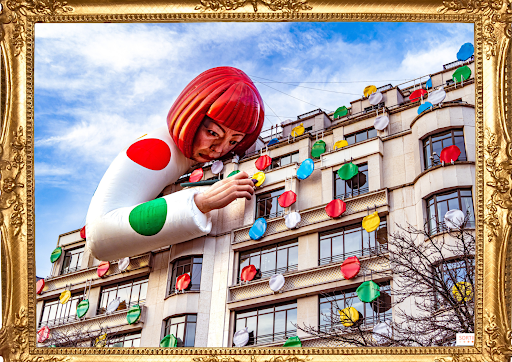
Most notably, though, a larger-than-life figure of Kusama leaned over the roof of the Louis Vuitton headquarters in Paris, painting colorful polka dots on the building. This was accompanied by another hyper-realistic figure standing in the middle of the Rue du Pont Neuf.

A striking piece in the building caused mixed reviews of the campaign as a whole. A robot of Kusama repetitively painted polka dots on the glass separating viewers from the storefront. Kusama’s art is famously drawn from the hallucinations she has had for most of her life. Her mental illness is something she tries to bring light to, as seen in her early performance art. But some found the reference insensitive. Others argued it brought needed attention to the mental conditions she faces.
Whether you believe it was performance art or an out-of-touch display, it still made viewers feel something. The purpose of the installation evoked a feeling that led to an overall message. Making art of that scale is bound to attract opinions and feelings. Kusama had an intention, not a code or script to follow. To create is to push boundaries. In my opinion, I think the piece accomplished this.
I highly recommend watching ParisianVibe’s YouTube video covering the Paris exhibition. It discusses the in-depth mental conditions and background of Yayoi Kusama. (It will also be linked at the end of the article.)

Feel My Heartbeat
Overall, art requires a heartbeat. True, expressive, immersive, human art will always require a heartbeat with emotion and imperfection. Argubally, AI seems to be wiggling its way into everyday life. From companies investing in data centers to AI servers in drive-thrus. But as long as creatives have a heartbeat, they won’t be able to replace real art anytime soon.
Sources:
Flight, T. [Thomas Flight]. (2025, November 4). Why AI "art" feels so wrong. YouTube. https://youtu.be/ZFitkz5VJvI
Wikipedia. (2011, February 12). File: Birth of Venus Botticelli.jpg. https://en.wikipedia.org/wiki/File:Birth_of_Venus_Botticelli.jpg
Buttress & Snatch. Swimwear moodboard. https://www.buttressandsnatch.co.uk/swimwear-moodboard
Tate. An introduction to Yayoi Kusama. https://www.tate.org.uk/art/artists/yayoi-kusama-8094/introduction-yayoi-kusama
Kim, Y. (2022, December 1). You can see some of Louis Vuitton's most iconic collabs at Art Basel Miami. Hypebae. https://hypebae.com/2022/12/louis-vuitton-art-basel-miami-beach-exhibition-yayoi-kusama-takashi-murakami-collaborations-images
ParisianVibe. (2023, January 12). Louis Vuitton x Yayoi Kusama in Paris: Everything you should know. YouTube.

0 Comments
There are no comments yet. Be the first one to post one!