
Between Us: An Interview With Artist Mia Jones By Georgia Stewart
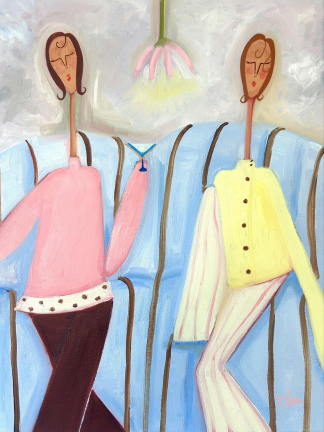
When looking at Mia Jones’s art, women can almost immediately recognize themselves, or a memory they have, even though they have never lived Mia’s exact experiences. The most common comment Mia receives about her art is that people see themselves and their friends in it, and that this feeling is rare. It's interesting how underrepresented scenes of feminine intimacy like these are, especially considering how universal the experience is. These paintings do more than just depict feminine intimacy and friendship; they actively produce it between the artist, the viewer, and other viewers. Mia’s work mirrors its own themes through parallels in her process, memory, intimacy, and viewer reception.

Mia Jones, The Night In, 2026
Mia Jones is a 21-year-old Nottingham, UK-based artist. Through her treasured memories of her close-knit friend group from university and her first experience living with a group of friends, Mia became very interested in the small, intimate moments women share. In her art, Mia focuses on scenes of lounging, chatting, sharing food, and women simply existing together in a space. Scenes like this are often overlooked and widely underrepresented because they are seen as simple, soft, feminine, or domestic. Mia’s paintings take these fleeting moments and remind us that they are something worth documenting and preserving.
Mia’s paintings feel important exactly because they depict a moment where nothing obviously important is happening. Mia described how the moments she remembers most with her friends are the ordinary conversations and small moments spent together, which many viewers can relate
to. This is mirrored in the intimacy of the composition, as the figures face each other and literally mirror one another, and in the intimate enclosed spaces in which they are depicted.

Mia Jones, The Banquette, 2026
Viewers can recognize the scenes as similar to their own memories, and they can also recognize the overall aesthetic of Mia’s work as reminiscent of early-2000s girlhood. These paintings feel recognizable through pastel palettes, fashion choices, interiors, patterned furniture, and soft lighting that appear so consistently throughout her work. These details trigger a broader shared memory associated with girlhood and adolescence. This nostalgia becomes communal because so many of Mia’s viewers grew up surrounded by the same aesthetics and experiences, making
the paintings begin to foster a connection before the viewer is even able to fully analyze the subject matter.

Mia Jones, The Olive Plate, 2026
Mia’s work sits somewhere between personal and collective memory. The scenes emerge from Mia’s own experiences and friendships, but they remain open enough for viewers to insert themselves into them as well. The familiarity between the situations Mia depicts and the general nostalgia the aesthetic evokes creates a feedback loop in which viewers can emotionally connect with the artist and one another through mutual recognition and nostalgia. The most beautiful parallel here is that this feedback loop mirrors the very thing Mia is depicting: feminine connection.

Mia Jones, Between Us, 2026
Mia’s paintings are able to function socially in the same way that female friendship itself does. These paintings depict intimacy while also generating intimacy between viewers, making this work become communal rather than simply observational. The ambiguity of these works is a key part of this. The women in these paintings could be talking about something mundane or a major life event. The flexibility of how these could be received allows viewers to project their own memories, friendships, and experiences into these paintings. Through this, these paintings become emotionally collaborative spaces rather than fixed narratives.
Mia reached burnout with her art after being pressured to make it perfect, useful, or profound while she was in school studying art. She eventually decided to reject strict realism and instead embrace a more abstracted depiction. The elongated figures and simple spaces may initially read
as whimsical or exaggerated, but the style actually seems to mimic the structure of memory itself.

Mia Jones, Double Act, 2026
All of Mia’s artworks are based on memories, even down to the outfits she and her friends often wear and the furniture in a space. She paints with limited references and without sketching on the canvas beforehand. She goes straight into painting and mostly works from her own memory, which is what allows these works to be so emotionally and atmospherically charged without hyper-specific details.
Memory often preserves the emotional atmosphere more strongly than literal visual accuracy, and Mia’s paintings reflect this through her use of warm, inviting color, interiors, clothing, and lighting. Memorable sensory details such as lamps, patterned floors, and wine glasses recur because they anchor these memories. Her work prioritizes emotional realism over optical realism.
After rejecting outcome-driven institutional art practices, Mia described her process as more childlike and free, and explained that this feels very full circle to her. Mia's art is now more instinctive and playful, connecting with the way she approached it as a child. In this, her art not only depicts girlhood nostalgia, but it also creates it through her reclaimed sense of childlike freedom in her process. The sincerity of Mia’s work is what allows it to resonate so deeply with so many female viewers and to let these parallels naturally emerge.
Mia’s work is unique because every aspect of it folds back on itself. Her paintings depict connection, but they also emerge from it, preserve it, and generate it. This repeated mirroring, revealed through Mia’s own memories, process, and the viewer's reception, gives the work a sincerity beyond surface-level nostalgia or aesthetic appeal. Viewers are not simply viewing Mia’s memories but actively participating in the same intimacy her paintings portray. Mia’s work transforms fleeting moments of feminine friendship into shared emotional experiences that continue to expand outward through recognition, nostalgia, and collective feminine memory.
See more of Mia Jones on her social media.
Instagram: @artbymiajones
TikTok: @artbymiajoness
0 Comments
There are no comments yet. Be the first one to post one!