
The Problem With Endless Inspiration by Georgia Stewart
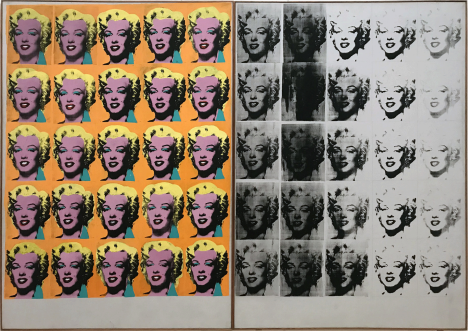

Andy Warhol, Marilyn Diptych, 1962
In an era of constant scrolling and consumption, artworks are often viewed through a lens of instant comparison. Given how social media functions in most of our lives, users are, on average, exposed to over a thousand images every day, many of which are consumed passively. This can have a massive effect on visual art specifically, as artists and viewers are exposed to an unlimited archive of references at all times. With seemingly endless visual consumption, artists are under constant pressure from influence and reference, while viewers simultaneously find originality harder to recognize. The overwhelming amount of visual consumption the internet allows can condition viewers to view artwork with immediate comparison, creating exhaustion, creative paralysis, and the idea that everything has already been done.

Cory Arcangel, Super Mario Clouds, 2002
Historically, artists developed their styles within smaller circles of influence through schools, movements, or mentors. Alternatively, contemporary artists have instant access to millions of artworks, references, and process videos. This may seem like an advantage at first, but it can
actually be quite overwhelming. Platforms like Pinterest, Instagram, and TikTok allow artists to organize their ideas through endless references before beginning a work. These references aren’t inherently bad, as they have been used all throughout history, but constant and seemingly infinite exposure can make it difficult to distinguish personal instinct from external influence. Artists now may struggle less with finding inspiration and more with escaping it.
Unlimited access to inspiration and reference can actually be weakening or maybe even paralyzing. Seeing countless successful artworks, combined with the inherent artistic pressure to be “original”, creates pressure to make something entirely unique, which is impossible and becoming increasingly so. An artist may feel a sense of anxiety as every new idea reminds them of an artwork or aesthetic that pre-exists. Awareness of trends, trends that seem to shift more rapidly every day, online discourse, and recognizable styles can make experimentation feel riskier. When every possibility seems to have already been explored, committing to an idea can feel overwhelming rather than freeing. Many artists may find themselves spending more time filtering through influences and second-guessing their ideas than developing their personal visual style. Rather than creating freedom, infinite access creates pressure and over-awareness.

The endless exposure enabled by the internet has not only impacted the creation of artworks but also the viewing experience. Viewers are also subjected to the same enormous amounts of imagery daily through scrolling and algorithm-driven feeds. The constant exposure we have become accustomed to has trained viewers to quickly categorize artworks into aesthetic categories or trends. Viewers often notice similarities before differences, and originality can become harder to recognize in an oversaturated visual environment. Contemporary artworks can feel like something the viewer has already seen, as they are compared to thousands of remembered images. The standards by which viewers consider artworks “original” have become increasingly unattainable as a result of this exposure. Audiences may now expect novelty in a way that is almost impossible to satisfy.

Sherrie Levine, After Walker Evans, 1981
Due to trends and algorithms, artists all around the world may be exposed to the same references and influences simultaneously. Additionally, the ability to see which artworks gain visibility and praise may push artists to follow a specific style, aesthetic, palette, or composition. This may create the feeling of a flattened or globalized aesthetic in art. With the development of the internet and the way it has completely changed how people create and view art, maybe originality should no longer be viewed as a complete invention.
Artists today create art while surrounded by an endless sea of influences and comparisons. This oversaturation affects not only the artist but also the viewer, changing how people experience and perceive art. It's not that originality has completely disappeared, but its conditions have certainly shifted, and maybe our definition of it should shift too. Originality now may exist less in complete invention and more in interpretation, combination, perspective, and intention. The internet did not eliminate originality in art, but it transformed influence from something gradually encountered into something constant, immediate, and impossible to escape.

Marcel Duchamp, Fountain, 1917
0 Comments
There are no comments yet. Be the first one to post one!