
A Lesson in Misquotations: Revisiting the Famous Quote on Fantasy and Escapism By Harmony Gibson

A few months ago, I walked into Barnes & Noble and was greeted by a massive cardboard cutout adorned with a quote:
“Fantasy is escapist, and that is its glory.”
Immediately, I was torn.
Fantasy isn’t just escapist, I thought.
Or at least, it shouldn’t be.
For weeks afterward, I ruminated on this. Why did it rub me the wrong way? What stuck with me about it?
Naturally, it aligned with a lot of my thoughts on modern writing—the fallacies and faults that accompany modern art and trends, and the publishing industry in general.
(Check out some of my more recent articles [here] and [here] if that interests you…)
Since it was still on my mind, I researched the quote and, to my surprise, it became even more interesting.
When you search the quote online, you’re flooded with images attributing the words to Tolkien. Images like these:

Immediately, I knew something was amiss.
Tolkien’s most famous stories were rooted in the real world. His invented languages were heavily influenced by real languages and linguistic traditions (Elvish is heavily rooted in Welsh linguistic tradition), and the themes in The Lord of the Rings have everything to do with morality and ethics. The fantasy elements he so vividly paints are rooted in mythology, folklore, and moralistic fables, all drawn from his own personal interests, academic studies, and experiences.
Fantasy, for Tolkien, never seemed like simply a place to run away to. It was a way of exploring the things that mattered in the real world through a world that didn’t exist. And that was evident in the stories he told that held real parallels that one could relate to and see themselves in despite their fantastical settings or otherworldly laws.
After researching further, the quote was redirected to Ursula K. Le Guin, an author famous for her Earthsea series, a sweeping fantasy epic in its own right.
(I have yet to read the series, but it’s renowned as one of the great works of modern genre fiction.)
I was all but ready to dispute her words—to argue that all good writing, whether genre-based or not, should stem from human realness.
In fact, it aligned with a rant I recently went on to a trusted friend regarding the implementation of the love triangle as a literary device, which I will now divulge here, if you, reader, will indulge me.
The Love Triangle

Of course, this introspective discourse arose in my mind due to my consumption of a recently released Amazon Prime romantic drama series (which I won’t name here because it’s irrelevant, really).
I came to wonder: why is it that love triangles have become such a common thing in any genre, really? I had to ask myself, why am I so averse to them as a concept?
And I realized, it’s not a love triangle which I am averse to—on the contrary, I find them to be quite enjoyable at times. Who doesn’t love a little drama and romance? It’s the façade of one that I dislike.
When you think of a love triangle, chances are you think of Twilight or The Hunger Games. At least, those are very relevant, recent pop-culture examples of the love triangle.
But—even within those respective franchises—the love triangle between the characters first and foremost meant something beyond “do I want the lean blonde one or the husky brunette?”
In each franchise, you had a character facing two distinct paths. And each “love interest” entirely represented those paths.

In The Hunger Games, the romance is by far the least important part of the story. And when you critically look at the story itself, you understand that it’s never really about Katniss choosing between Gale or Peeta.
Katniss is what we call the reluctant hero. She by no means wants to start a rebellion. She’s in survival mode, barely scraping by to make ends meet and provide for her family. She doesn’t sneak through the District 12 gate and hunt for the thrill of it. She’s doing it out of necessity.
The rebellious aspect is almost incidental. It isn’t until she’s forced to face the conflict head-on that she needs to choose.
And Gale isn’t just a love option. Nor is Peeta.
Gale represents staying stuck in survival mode, comfortable in discomfort. Not happy, but alive. Inevitability. He represents the world as it is: violent, harsh, and unforgiving, and the willingness to become hardened enough to survive within it.
Peeta represents hope. He’s the way out, the light in the dark. He’s nothing like the violent, cruel world they’re in. He’s kind and naïve and selfless in a world that demands hardened cruelty.
Ultimately, her choice in him represents her larger desire to protect that.
That’s what makes the love triangle work.
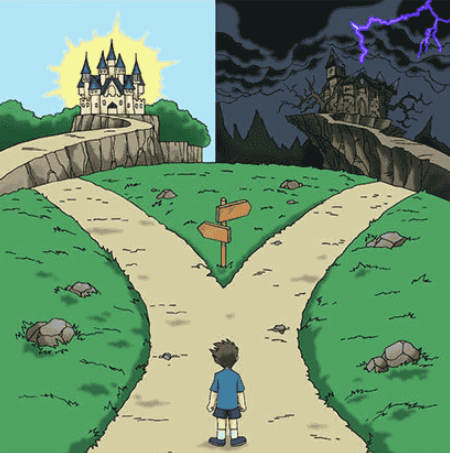
It isn’t really a triangle.
It’s a crossroads.
And though Twilight feels like a more pulpy romance, even it has its message built within the romantic choices: she’s literally choosing between life and death. It begs the question: what does true love demand from us, and are we willing to pay that price?
The romance is not merely there to give the reader something to root for. It gives the protagonist a physical, emotional, and sometimes fantastical representation of the choices she is already being forced to make.
And that, to me, is the difference between a literary device and a gimmick.
A love triangle can be meaningful.
Fantasy can be meaningful.
The problem isn’t that these things exist. It’s when they exist without anything underneath them.
And so, we come back to the question:
Is Fantasy Just Escapist? Is That Really Its Glory?
I really don’t think so.
Because the reason it exists is to still challenge the reader with these thoughts. To take fantastical, imaginative worlds and have grounded, human realizations arise from them. To make us look at something impossible and somehow recognize ourselves within it.
That is its glory.
Above all, it still must grasp us through connection, not simply thrill us. It should make us feel something about ourselves, our world, or the people around us. It should give us some small realization that we can carry back into reality with us.
Otherwise, it’s simply a distraction—an indulgence which asks nothing of us.
And where is the glory in that?
But despite my misgivings, something still urged me to dig deeper into the words that brought such discourse to me.
And sure enough, there was the truth.
Layered under inspiring stock images with false, paraphrased misquotations was the reality.
The quote itself is a paraphrase taken from a larger context, which Le Guin commented on in her book of essays. And when I discovered the proper quote from said work, I found myself abated.
The True Quote

It reads:
“For fantasy is true, of course. It isn’t factual, but it’s true. Children know that. Adults know it too and that’s precisely why many of them are afraid of fantasy. They know that its truth challenges, even threatens, all that is false, all that is phony, unnecessary, and trivial in the life they have let themselves be forced into living. They are afraid of dragons because they are afraid of freedom.”
― Ursula K. Le Guin, The Language of the Night: Essays on Fantasy and Science Fiction
And this—exactly this—is why the initial quote troubled me and rang so false that it haunted me for weeks.
It’s funny how, despite knowledge being at our fingertips, we still rush to share things without their true context. We see a quote that sounds profound, pair it with an aesthetically pleasing image, attach a famous name to it, and suddenly it becomes something entirely different from what the person actually meant.
Because Le Guin wasn’t glorifying escapism above truth in fantasy at all.
In fact, she perfectly articulated just what is wrong with that exact sentiment.
Fantasy is an escape.
But that doesn’t mean it is an escape from truth.
So, yes.
Fantasy may offer us an escape from reality.
But its greatest glory?
Doesn’t lie in leaving the real world behind, but in using the unreal to reveal something essential about what it means to live within it.
That, I think, is what storytelling is supposed to do.
Whether we are reading about vampires, wizards, dystopian governments, impossible love triangles, dragons, or worlds that could never exist, there should still be something recognizably human waiting for us underneath it all.
Otherwise, what are we escaping for?
After all my ramblings, I suppose the greatest takeaway from this article is to double-check a quote next time you share it.
And maybe, to ask yourself what about the words truly resonates with you,
and whether you like (or dislike) them because of what you’re projecting onto them,
or because of who said or meant them to begin with?
-HG
0 Comments
There are no comments yet. Be the first one to post one!