
The Return of Physical Media By Veronique Lhuillier
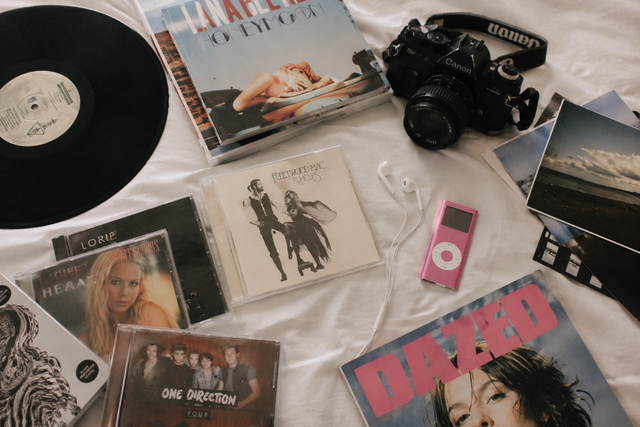
For almost every birthday as a child, I would ask for a new CD to play on my purple Dora the Explorer boombox. My collection ranged from Britney Spears to One Direction. I’d transfer music into my matching purple iPod Nano. Until I finally downloaded Spotify in 7th grade, and my CD collection began to collect dust.
I stopped asking for more CDs. With Spotify, virtually every song I could ever want was available with just a few taps. It was cheaper, easier, and infinitely more convenient.
Then, just before I graduated high school, I found myself purchasing a record player. I still stream music daily, but something in me longed for that physical act of choosing an album and listening to it all the way through.
And as it turns out, I’m not the only one.
Physical media is making an unexpected comeback across Gen Z. Vinyl records have reached sales numbers not seen in decades. BookTok is promoting independent bookstores. Analogue cameras are back in style despite the cost of purchasing and developing film. Even magazines, DVDs, camcorders, and point-and-shoot digital cameras have found new life among the young people who were born into a digital world.
This might seem contradictory, as this generation has never known a world without smartphones, streaming services, and social media. If anyone would embrace digital convenience wholeheartedly, it would most certainly be us. However, many of us are in search of something digital media struggles to provide: permanence.
When everything we consume exists behind a subscription, ownership begins to feel like an illusion. You lose your subscription, you lose your movies, music, and even photographs. We have access to more media than any generation before us, yet it somehow feels less like it actually belongs to us.
Owning a vinyl record, magazine, or DVD is different. It doesn’t require Wi-Fi or a monthly subscription, and it can’t be revoked because a company lost its distribution rights. These tangible items occupy physical space, becoming part of our homes and our routines.
While streaming services offer endless options and social media trains us to scroll after a few seconds, physical media resists that pace. A vinyl record demands our full attention for around twenty minutes before we can flip the disc. A magazine lets us linger on a single page instead of opening ten browser tabs at once. A film camera forces you to capture moments with intention, because you have a limited number of shots. These limitations are all part of the experience.
Perhaps that’s why nostalgia is such a powerful force among Gen Z. It isn’t simply about romanticizing the past, as many young people buying vinyl records or MP3s weren’t even alive when those formats were at their peak. This generation craves a slower, more tactile way of interacting with the media we consume. In an age where so much of life happens through screens, physical objects feel grounding and refreshing. They remind us that not everything has to be shared instantly or stored in the cloud.
Recently, I decided to start buying second-hand CDs again. They’re inexpensive, used, and probably unnecessary in an age where every song I want to listen to is already on my phone. But slipping a CD into a player allows me to listen to music more intentionally, rather than as background noise. That’s what the revival of physical media is all about—not rejecting technology, but making room for experiences that can’t be skipped or recommended by an algorithm.
0 Comments
There are no comments yet. Be the first one to post one!