
David Lynch and the Manic Pixie Dream Girl By Harmony Gibson
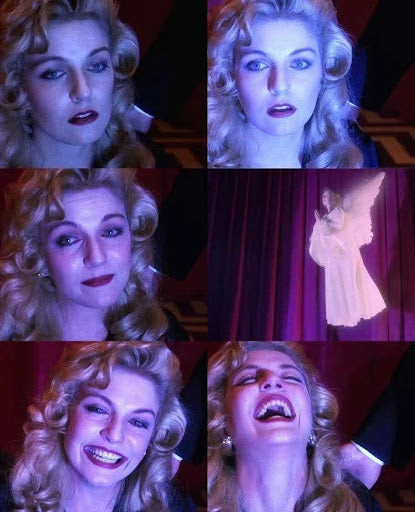

What is the manic pixie dream girl?
Odds are, you’ve heard of the term “manic pixie dream girl,” or most definitely have encountered the archetype, especially in recent media. The term is used to categorize a specific type of female character: the kind that’s strange yet desirable, commonly paired alongside a male lead who’s her total opposite. She’s the girl every girl wants to be—cool, different, charming but still hot and/or cute; and the one every guy wants.
Nathan Rabin, an American writer who wrote for The A.V. Club, coined the term as a scathing commentary on patriarchal archetypes within writing. He describes the manic pixie dream girl as a character who “exists solely in the fevered imaginations of sensitive writer-directors to teach broodingly soulful young men to embrace life and its infinite mysteries and adventure.”

The manic pixie dream girl as an archetype is a divisive one.
Overall, it’s deemed antifeminist or rooted in misogyny. In theory, it reduces a woman to her desirability, and that desirability (within the archetype) relies heavily on how she is beheld through the male gaze. Thus, the manic pixie dream girl becomes less of a fully realized character and more of a man’s fantasy: objectifying women while stripping away the nuances and reality of their lived experiences; a 2D caricature of what men think a woman should be, and what she should desire.

What happens when the manic pixie dream girl is the main character, and not the love interest?
David Lynch takes the trope (before it was ever officially coined) and implements it in a way that completely reverses the dynamic.
He asks who the manic pixie dream girl really is.
And he doesn’t hold back from showing the ugliness that she faces in a world that reduces her to the archetype’s characteristics. He shows the desirable and the undesirable, the façade and the truth.
His female characters are often strange, beautiful, sexual, mysterious, innocent, dangerous, or some impossible combination of all of these things at once. But unlike the traditional manic pixie dream girl, Lynch is interested in what happens when the woman herself has to exist beneath the image others have created for her.
That duality makes up a core, recurring structure in Lynch’s storytelling.
Lynch’s female characters might embody many of the characteristics associated with the “manic pixie dream girl,” but he uses those characteristics to examine what happens when a woman becomes trapped inside the gaze of others.
The women he writes aren’t desirable just because they’re quirky or strange, nor are they placed into a story solely to transform a male protagonist. Instead, their desirability becomes part of, or central to, the conflict. Lynch asks what it means to be seen as an ideal, a fantasy, a mystery, or a sexual object while simultaneously having an internal life that remains hidden from everyone around you, one that no one seems to ask about until it’s too late.
We see this most clearly with Laura Palmer.

Laura
In Twin Peaks, the small, sleepy town is completely shocked by Laura’s death. She is remembered as beautiful, kind, intelligent, popular, the perfect girl. Her murder uproots the idyllic image of the town itself, but as her life is investigated in the wake of her death, we discover how shallow the perception of her truly was.
Everyone seems to know her, or at least some version of her. But no one ever knew the true version of her.
Donna, her best friend, is an especially distinct example. She idolizes the girl she thought Laura was the beautiful, bad girl who all the boys wanted, who was rebellious and mysterious and seemed to possess freedom that Donna herself lacked. Yet the more we learn about Laura, the more that image begins to fall apart. What appears from the outside to be rebellion and sexual freedom is also deeply connected to the trauma and violence she is experiencing.
Laura’s sexuality in particular becomes something that others project onto her.
The men around her see a desirable girl. Her classmates see a beautiful and popular girl. Donna sees a rebellious girl who seems to have access to a world beyond their small town. But beneath these contradictory ideals is a young girl struggling to make sense of an increasingly violent and terrifying reality. This is where Lynch deviates from the standard use of the archetype.
The traditional manic pixie dream girl is desirable because she seems to exist outside of ordinary circumstance or expectations. She’s spontaneous, sexual, strange, charming, and free.
Lynch asks what happens when that same perceived freedom is actually a prison, or a performance; and how or why the world might interpret a woman’s suffering as evidence of her freedom.
Laura’s “bad girl” persona is not who she is. It is one of the many identities she constructs to survive.
Her tragedy is that even when she’s desperately crying for help, the people around her still only interpret her through the image they have already created of her in their minds.
This is one of Lynch’s most interesting variations of the manic pixie dream girl archetype. He doesn’t deny that Laura is beautiful, strange, sexual, or desirable. He knows that she is all of those things, and in turn understands the consequences and weight of it being the only thing others see.
And yet, If Laura Palmer represents the woman trapped beneath an image constructed by an entire community, Mulholland Drive takes a more introspective approach.

Diane
Mulholland Drive is an especially interesting take on the manic pixie dream girl because the subject of the trope becomes the object of affection from another woman’s point of view. There are still instances of the male gaze which become entangled with identity, especially in Diane’s case, but the film itself exists largely within the constructs of Diane Selwyn’s imagination, where she transforms Camilla into a damsel in distress: mysterious, vulnerable, helpless, and in need of only Diane’s protection.
In Diane’s imagined world, Camilla becomes Rita.
Rita is beautiful, frightened, mysterious, and seemingly dependent on Betty. She has lost her memory and has nowhere else to go. Betty, meanwhile, is everything Diane wishes she could be: sweet but capable, innocent but captivating, commandeering yet desirable. She arrives in Hollywood and immediately seems destined for success. Men are drawn to her. She gets the audition. She is talented. She is wanted.
Betty is, in many ways, Diane’s own manic pixie dream girl fantasy.
But Lynch, as ever, deepens this. Diane is at once the one who gets the girl and the one everyone wants. She’s the objectified and the objectifying. She’s the product of the ‘male gaze’ that idealizes the manic pixie dream girl while at once reinforcing those patriarchal constructs onto her own imagined version of her love.
Her fantasy collapses when Diane realizes that Camilla isn’t the idealized woman, she imagined her to be. Camilla isn’t Rita. She’s not helpless, eternally devoted, or waiting for Diane to rescue her and instead has her own desires, ambitions, and relationships that exist outside of Diane’s fantasy.
And Diane’s realization that neither she nor Camilla are the manic pixie dream girls she fantasized them to be becomes the ultimate blow to her psyche.

In the end, the ‘dream girl’ really is a dream.
And Lynch forces the imagined character to be the consequence of the imaginer.
In Mulholland Drive, Diane creates the projection she becomes trapped in, and in Twin Peaks, Laura is trapped in the town’s projection of her.
In both stories, the character becomes inseparable from their archetypal image. And Lynch provides commentary on the dynamic itself.
In many of his films, there exists a woman others obsess over not simply because of who she is, but because of who they want her to be. She becomes an ideal, a mystery, a fantasy, a victim, a sexual object, a savior. And every time, Lynch eventually pulls back the curtain to reveal the person underneath the archetype, and the people who have constructed it. Nearly every time, the resulting consequence is the downfall of the desired, the desirable, or in some cases, both.
Lynch’s characters are manic pixie dream girls. But not in the traditional sense.
They don’t exist only as to fulfill some male fantasy. Their stories allow us to see the consequence of confusing fantasy with identity, of not seeking to understand others outside of how they exist in our minds.

-HG

0 Comments
There are no comments yet. Be the first one to post one!