
Performing Happiness: Interview With David Van Ness and Shay Linder
Performing Happiness: Interview With David Van Ness and Shay Linder By Cecilia Wren

During my interview for Milk Room the topic of combining art and robotics came up. I instantly thought of the New Media Art Program at Northern Arizona University (NAU). As an art student, at NAU, you have to take more than one discipline and one of my choices was New Media. So what is New Media? New Media is a fairly open discipline, you can do sculpture, digital art, oil painting, 3D modeling, or none of those options. There is no one medium that New Media is confined to, it is a new way of thinking about and creating art. New Media is an idea first way of creating art and the medium is a way to communicate those ideas.
I went to the New Media Caucus in March and saw artists from all over the United States who created robots to cross the Andes Mountain range, solar servers for artist spaces, and robotic blow up dolls for rabbits. As someone close to that program, I wanted to share some of the exceptional work that I see every day. Not only am I close to the New Media program I am also close friends with Shay Linder and their faculty mentor, David Van Ness. In one of our daily encounters I got the chance to interview them both about their upcoming exhibitions.

David Van Ness is a professor at NAU who participates in the Interns to Scholars program which matches faculty doing research to undergraduate students who are interested in their research. As a result of this program Shay Linder has been integrated into part of his creative process. Linder is a senior New Media student whose work revolves around the integration of technology into fiber arts. They found out about the Interns to Scholars program through Van Ness after taking a few classes with him.
“It sounds cheesy to say, but I wasn’t sure about the New Media program until I met David,” says Linder. Linder talked about how they weren’t sure about how they would fit in as a fine art major with their background in fiber arts and computer science, but after seeing how Van Ness worked they realized that this was the place for them. Van Ness has done the Interns to Scholars several times before, but this collaboration with Linder has been one of the most beneficial for his process. Van Ness said that Linder was one of his best students and when Linder protested about how they almost failed some of the classes that he taught, Van Ness talked about how you can be a great artist but a terrible student and those people are usually the most successful. Van Ness also praised Linder’s ability to think outside of the box and challenge him to use more techniques that he wouldn’t have even considered.

During the interview Van Ness and Linder talked about their experiences being a New Media artists. In his graduate program, Van Ness talked about being known as the “techno wizardry guy” and then transitioning to making art about custom car culture in Detroit. After starting his career as a professor, he became known as one of the earliest 3D print artists. Now that he is tenured faculty at NAU, Van Ness wanted to work on new interesting things and robotics was just that.
Linder originally went into the New Media program with the intention to learn 3D animation in Blender, but then discovered the wide array of things that fell within New Media. They recently created a large crochet tapestry that runs on a treadmill of an ouroboros (snake eating its own tail) combining fiber art and the robotics that they were learning from Van Ness.Linder talks about their background experiencing similar mental health struggles to Van Ness. They are both vocal about their mental health and talk about how that open-ness is what drew them together.
Van Ness and Linder are working together on upcoming shows in multiple galleries across the country. Their show, Happiness.performed, is about Van Ness’s experiences performing and viewing social norms and manipulating them into something even weirder and more offputting. Van Ness talked about his family history being important to his work. He grew up with a father who dedicated his life to mathematics and the discovery of the fractional Brownian motion. This led to his interests in combining the world he grew up in with the art world that he loved. Van Ness also talks about how his mental health and autism affect his practice. His piece I’m Fine is about his interaction with a professor in his undergraduate years of college. When this professor asked Van Ness how he was doing and he answered truthfully, the professor told him that that is not the correct response that you should give to someone. This led Van Ness to create I’m Fine, a robotic arm with a screen that follows the viewer around the room. The screen plays a video of Van Ness’s face, when the viewer asks “how are you?” it will only respond “I’m fine”.

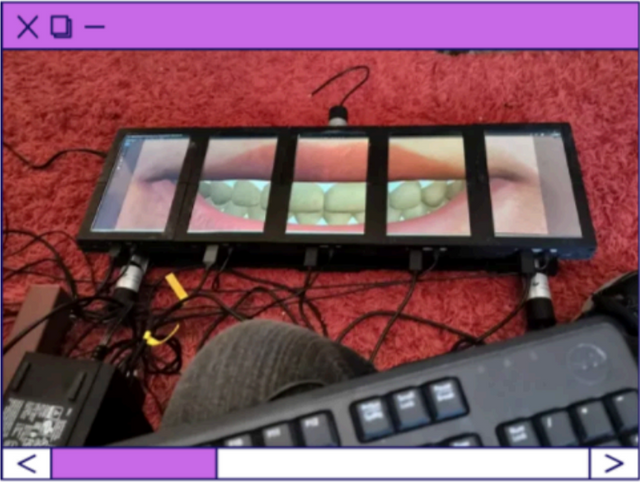
Since making significant progress on I’m Fine, Van Ness and Linder have started working on multiple pieces. One piece that Linder wrote the code for is the Emotion Piano, a web data scraper that turns the general emotions found in the trending google searches that day into a musical piece to be played on two pianos. Another piece that is still in process is The Hugger, a robot that you can hug and that will hug you back, covered in stuffed animals similar to Mike Kelly’s Deodorized Central Mass with Satellites. They duo are currently focused on You Should Smile More, a combination of Linder’s 3D printing and Blender knowledge and Van Ness’s physical robotics and coding. The piece will be five monitors with a mouth that moves up and down to perform a smile. Van Ness and Linder recently received a Arizona Commission on the Arts grant and are awaiting response on the Guggenheim fellowship.
You can see updates for the progress of their collaborative and individual works on: David Van Ness: http://www.davidvannessteachingportfolio.com/
Shay Linder: https://www.instagram.com/shay.linder/
0 Comments
There are no comments yet. Be the first one to post one!