
Simulating Reality: The Rise of Job Simulator Games By Kayla Doria Ward
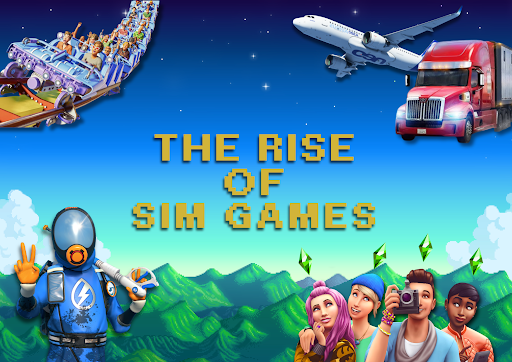

Whether you’re a casual or hardcore gamer, you’ve probably seen the rise of simulator games in the past decade. Powerwash Simulator, Supermarket Simulator, and American Truck Simulator are a few popular names you may recognize. What do all these sim games have in common, though? They aren’t simulating a futuristic or zombie-ridden world. They are common jobs.
Powerwash Simulator doesn’t include fighting off zombies or taking out enemies. You are simply powerwashing! While DLC and add-on packs allow for some unique universes such as Star Wars and SpongeBob, you are still just cleaning away dirt.
This genre ranks roughly third to eighth overall in the global video game industry, pulling in billions of players with each new release or update. I’ve decided to find out the “why” behind it all. Why are millions who work at supermarkets or haul trucks cross-country coming home and doing it all again, but virtually?
Escapism
It’s no secret the job market is in rough shape, and the cost of living seems to be rising by the minute. Because of this, most Americans can’t live comfortably, or even get by, with just one job. The stresses of being underpaid and overworked take a tremendous toll on both your physical and mental state. So instead of getting off a shift and watching a show or relaxing, why are people deciding to clock in virtually for no pay at all?
To escape. Lin Zhu, researcher in education, psychology, and methodology, found sim games work because “it captures people's instinct to escape from realistic difficulties and their yearning to chase a peaceful and harmonious life”.

Life is unpredictable. You can’t fully control how many hours you work a week or how many days you have off. Injuries, deaths, and layoffs don’t follow code. But virtual simulators do. You can control just about everything or anyone in a simulator. You can even control your social interactions.
Zhu further states, “It satisfies people's unwillingness to be lonely and their deep inner desire for the social interaction to get rid of the loneliness”. The Gallup World Poll recorded responses from 218,000 people across nearly 150 countries. They found around one in five people reported feeling lonely during a typical day. Sims such as The Sims and Stardew Valley are popular examples of this.
The Sims famously allows you to control every aspect of a character's life. From how they look, talk, live, and work. Stardew Valley follows conversations in your town and lets you choose what you spend your energy on. These sim games are cashing in on fixed social scenarios. Allowing the player to choose and control interactions, not any outside forces.
Ideal Work Environment
Control is an overarching theme in sim games. Just like the social interactions, you can control various aspects of a sim. This is what attracts and hooks most people. The idea of productivity and growth, and a lack of hierarchy, gives the player an ideal, fair work environment. No nepo babies or unfair promotions in a player's virtual workplace! It doesn’t sound too bad, does it?
On the track of growth, most sim games are fairly simple when it comes to reaching levels or goals. If you complete x amount of tasks, then you are guaranteed a new item or a new level. No matter how complex the task, it really boils down to clicking or dragging a mouse or mashing buttons on a controller. Along with the gameplay being easy, the environment is as easy and peaceful as the tasks.
Finding a new job in Powerwash Simulator or “driving” hours in a truck in American Truck Simulator are fun because of this ease of environment. It no longer feels like hard labor. Since everything is made peaceful, the environment is calming instead of irritating or exhausting. No sun beating down on your back while powerwashing. No speed limits or prolonged rest stops in American Truck Simulator.

Self-Determination Theory
Sim games prioritize society's general values of quantification, efficiency, and productivity. By logging hours or even days on these games, players buy into the idea of productivity instead of a work-life balance.
Self-Determination Theory works on three main pillars. Autonomy: The need to feel in control of your own life and choices, rather than feeling forced. Competence: The need to feel effective, skilled, and able to master challenges in your environment. Relatedness: The need to feel a sense of belonging, care, and connection with other people.
Jamie Madigan, author of Getting Gamers: The Psychology of Video Games and Their Impact on the People Who Play Them, cites Self-Determination Theory as a culprit for this indulgence of sim games. “Decades of research on Self-Determination Theory shows that activities that satisfy autonomy, competence, and relatedness are intrinsically motivating” and “well-designed video games hit on all three of these cylinders”. Madigan notes that it is “curious and sometimes baffling that people will willingly spend hours and hours playing games that simulate jobs that they wouldn’t enjoy nearly as much.”
Real Answers From Real People
This past weekend, Metrocon 2026 came to my town. So I decided to do boots-on-the-ground journalism and get the opinions of gamers and video game enjoyers. These are some of the more interesting and thoughtful answers I collected.
“A lot of IRL (in real life) jobs have designed their job tasks badly, failing to create the sort of mental engagement that keeps people...engaged. Like, I can enjoy doing a complex job fast in gaming because I can set my own flow to it. I'm not restricted to one single repetitive activity; I can do a repetitive activity if it needs to be done, but having the flexibility to change if needed or desired.”
“They [sim games] can be incredibly therapeutic. When I'm stressed, I'll play Euro Truck Simulator 2 and put on my favorite podcast. I can literally just spend hours at a time driving around and doing deliveries. I'm sure that it'd grow old fast if I did it for a living, but the advantage of simulators is that you can pick them up and put them down without any obligation whatsoever.”
“Work simulators give players control, progress, and ownership, making even everyday tasks feel meaningful and satisfying. More importantly, you actually see the results and rewards of your monotonous act. Whereas in real life that happens more rarely, it seems.”
Closing Thoughts
Life is hard, gaming is fun. With how little control most people have over living situations, under paid/lack of jobs, and affording to go out and socialize in real life, sim games seem to feed into these worries. Whether for better or worse, they seem not to have any real damaging effects if enjoyed in moderation. Now if you’ll excuse me, I have to try out powerwashing The Land of Ooo.
Sources
Kennett, T. (2015, May 5). Why do we play video games that feel like work? VICE. https://www.vice.com/en/article/why-do-we-play-video-games-that-simulate-work/
Critical Video Game Studies. (2021, November 5). Why are simulation games appealing? https://criticalvideogamestudies.com/why-are-simulation-games-appealing/
Green, S. (2015, October 12). VentureBeat: Why do we enjoy playing games that simulate jobs we would never want to do in real life? Center for Self-Determination Theory. https://selfdeterminationtheory.org/why-do-we-enjoy-playing-games-that-simulate-jobs-we-would-never-want-to-do-in-real-life/
Dankbaar, M. E. W., Alsma, J., Jansen, E. E. H., van Merrienboer, J. J. G., van Saase, J. L. C. M., & Schuit, S. C. E. (2016). An experimental study on the effects of a simulation game on students’ clinical cognitive skills and motivation. Advances in Health Sciences Education, 21(3), 505–521.
https://doi.org/10.1007/s10459-015-9641-x
University at Albany. (2020, November 24). A grad student explores the psychology behind a video game megahit in the COVID-19 era. https://www.albany.edu/news-center/news/2020-grad-student-explores-psychology-behind-video-game-megahit-covid-19-era
Phys.org. (2026, July). Global loneliness epidemic reveals complex dynamics. https://phys.org/news/2026-07-global-loneliness-epidemic-reveals-complex.html
Zhou, L. (2023, July 19). Getting ready for my simulation game: Market analysis. Medium. https://medium.com/@lorrainezhou607/getting-ready-for-my-simulation-game-market-analysis-1850ea971aa3
University of Rochester Medical Center. (n.d.). Self-determination theory of motivation. Center for Community Health & Prevention. https://www.urmc.rochester.edu/community-health/patient-care/self-determination-theory

0 Comments
There are no comments yet. Be the first one to post one!