
Buying Our Belonging By Keeley Haynes
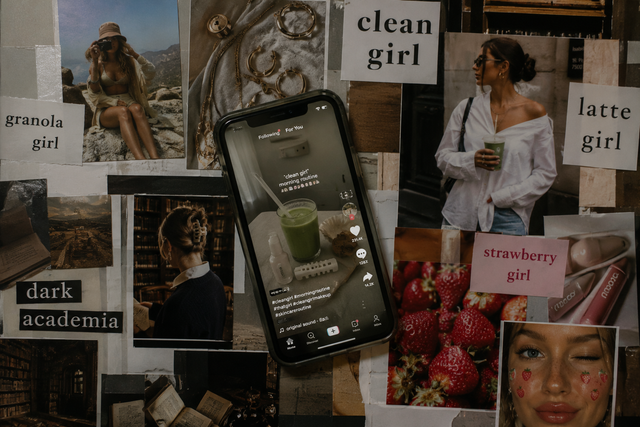
In 2021, “clean girls” took Tik Tok by storm, popularizing an aesthetic defined by neutral-colored wardrobes, slick back buns, ‘effortless’ makeup and clipped gold jewelry. Then came the “granola girls,” with their Chaco tan lines, flat-brimmed hats, messy waves and parachute pants. And in 2023, the rise of the brow-furrowing ridiculousness of the “tomato girl” and “strawberry girl” and “latte girl” aesthetics had social media users questioning what even are aesthetics anymore.
Throughout the 2020s, everything from Harry Potter to Zara Larson to Tuscan architecture has been assigned an aesthetic (Dark Academia, Y2K and 2000s Tuscan mom respectively). Each unique hobby, interest and personality type gets a specially-curated moodboard expressing the “aura” of each concept — which can act as fun inspiration for coming-of-age social media users figuring out which styles resonate with them and how to incorporate them into their lives, but can also alternatively confine people’s identities.
Aesthetics, which Merriam-Webster defines as the artistic and beautiful qualities of something, have been recognized by the general public since the 19th century. During the British Aesthetic movement (1860-1900), artists began producing “art for arts sake,” focusing on making beautiful works rather than meaningful ones. This thematic shift from meaning to beauty allowed the middle class to escape from the Industrial Age’s materialism and uniform gray, which mirrors how today’s Internet aesthetics often romanticize the mundanity of our lives.
Using aesthetics to categorize people and style is not a new concept. Think about the traditional stereotypes from classic teen movies like The Breakfast Club and Mean Girls: the guys sporting jerseys and sweat bands hang out with the jocks; the girls who dress more feminine are often deemed the popular girls; button downs and glasses are emblematic of academics, etc. These stereotypes aren’t necessarily harmful, so long as they don’t become exclusionary. Style communicates who we are, which attracts people of the same values and interests and allows us to build community. The punks of the 1980s and 90s, for example, used their socially-rejected dyed hair and distressed clothing to signal their defiance of conformity and traditional social norms. This unified people who felt equally frustrated by the oppressive world and allowed them to find community within their own subculture. Thus, aesthetics have the potential to be authentic forms of self-expression that forms belonging.
However, when aesthetics become less about authenticity and more about appearances, they begin to dilute our sense of self and (ironically) promote conformity. As culture became more visual-dominated with the emergence of social media platforms like Tumblr and Instagram, people started becoming more aware of each other and how each other dressed. People no longer had to go outside and interact and form bonds with the people whose aesthetics they thought were cool; they could simply model the outfits they were seeing on their phones and laptops to imitate the aesthetic. Teens knew from Tumblr that if they wore black and white, listened to The 1975 and carried around a copy of The Fault in Our Stars, they would be seen as a moody, melancholic, misunderstood adolescent, even if they had never smoked a cigarette in their life. By popularizing aesthetics, social media drove teens to base their styles on the trends everyone participated in rather than the pieces, people and ideas that personally spoke to them.
Now, aesthetics have become even more localized with the dominance of short-form video content. Every day, millions of “Outfit of the Day” and “Get Ready With Me” videos circulate platforms like Tik Tok and Instagram Reels. These videos show off the clothes people wear, the beauty products they use, the jewelry they don and even the tripods they prop their phone on — all with brand names included and oftentimes linked. This is how modern ultra-specific aesthetics take off. People slap a label on the way they style themselves, share the products they use and suddenly everyone is having a “tomato girl summer” because they’re able to identically imitate their desired aesthetic with the click of a button.
However,
Pressurized style-guides that act as a testament to wealth, beauty standards (The Reflector)
-
Rather than a tool of appreciating beauty, aesthetics have become one that forces beauty
Connection between aesthetics and over-consumption
-
When we feel toxic pressure to fit in, we will do whatever it takes to not be excluded
-
Visual culture inflated our desire to fit-in, and now we know exactly how to
-
Gives company leverage to prey on our insecurities and encourages us to buy products that allow us to fit in
-
Some aesthetics are even curated marketing campaigns or tools used by influencers to promote their beauty brands
-
Influencer marketing – hidden product placements in your favorite clean girls’ GRWMs and OOTDs
-
You’ll buy Hailey Bieber’s new strawberry lip treatment to fit the desired Strawberry Girl Aesthetic
Conclusion
-
Encourage social media users to be critical consumers
-
Authenticity is aesthetic because the true meaning of aesthetic is whatever you want it to be
-
Take the revolutionary risk to dress as yourself

0 Comments
There are no comments yet. Be the first one to post one!