
The Death of Third Places By Veronique Lhuillier
In 1475, the very first coffee shop opened its doors to the people of Constantinople, now known as Istanbul. It was far more than a place to sip on a warm cup of coffee. Cafes were spaces where merchants, writers, artists, and intellectuals gathered to exchange ideas, debate politics, share stories, and forge communities.
Centuries later, the coffee shop remains an enduring symbol of community, but its purpose has shifted. In America’s culture of hyper-productivity, cafes have become an extension of the office. Tables are lined with laptops while customers block out the outside world with noise-cancelling headphones and lose themselves in their work. The expectation is no longer to converse, but to produce.
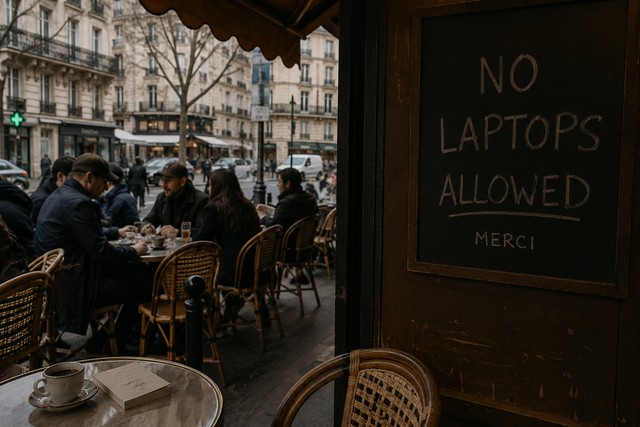
That contrast became especially apparent to me while I was living in Paris. During my time there, I noticed that most cafes did not offer free Wi-Fi at all; some even had signs that read “No Laptops Allowed.” Instead of rows of solitary tables, conversation filled the air as friends lingered over their lattes for hours and strangers read newspapers or simply sat in silence. The symphony of laughter and chatter made it the perfect place for people watching.
Coffee shops are just one example of a much larger phenomenon. Across cities worldwide, the third places that once gave young creatives and intellectuals room to think, experiment, and build community are disappearing—while, at the same time, becoming increasingly commercialized. Spaces that once asked for nothing but our presence now seem to demand something in return: our productivity or our wallets.
These days, simply spending time with friends often comes with a price tag. Meeting at a cafe means buying a six-dollar cappuccino. Seeing a movie requires a ticket. Even spaces meant to make art and culture accessible, like museums, often charge admission that makes spontaneous visits feel like a luxury. Public parks and libraries remain some of the few places where people can gather without the expectation to spend money, yet many of these spaces are shrinking due to funding cuts or are overlooked altogether.
Ironically, this shift comes at a time when we’ve never had more opportunities to connect online. Social media allows us to network on platforms like LinkedIn, share photos of our lives and work on Instagram, and join communities on Discord or Substack. However, these platforms are designed around output and visibility. They are places to showcase what we’ve already created. For creatives, there is still a need for these “in-between” spaces.
Third places matter because they allow us to step away from the pressures of work and school. They make room for curiosity, conversation, and exploration. Ideas emerge when we’re surrounded by observation, chance encounters, and the freedom to let our minds wander. Creativity has always relied on freedom, and freedom requires places where people can simply exist.
The solution isn’t opening more coffee shops, but rather learning how to occupy them differently. It’s closing the laptop, leaving the headphones at home, and lingering just a little longer after finishing your coffee. Before cafes became places to work, they were places to wander. Unstructured time isn’t always wasted. And perhaps that’s what young creatives need most right now—not another workplace, but space to observe, connect, and create.
0 Comments
There are no comments yet. Be the first one to post one!