
Breaking Down “Incel Horror” By Kayla Doria Ward
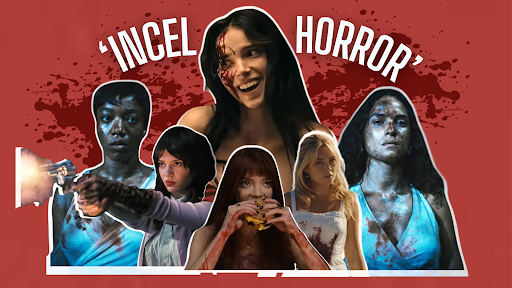
If you think Bear from Obsession is the victim, then this is not your safe place. In fact, this article is probably about you!
With the conversation and popularity surrounding Obsession, a new term has also gained attention. “Incel Horror”. Incel is commonly defined as “a term referring to members of an online subculture of primarily heterosexual men who are unable to find romantic or sexual partners despite desiring them.” The community is also known for misogyny, entitlement, and blaming women for their romantic struggles.
Typically, people either think of a “looksmaxxer” with rented sports cars or a top 1% commenter on Reddit. But what if I told you these incels could look just like your friend or coworker? In recent horror, we have seen incels start to take a different, more common form. Even the beloved Harry Styles played an incel in Don’t Worry Darling. “Incel Horror” is commonly defined as “in which the true source of terror is not a monster or supernatural force, but a man's sense of entitlement to women's bodies, attention, or affection.”
I’ll be breaking down the statistics and background surrounding women in horror, popular tropes of incel horror, and the terrifying “mansophere”.
Classic Horror Tropes
Throughout the decades, horror has evolved in various ways. Even remakes of beloved classics feel different due to the evolving themes in cinema. These changes boil down to the fact that horror is political. It draws from real life and real fears. Some popular premises we are seeing in this decade are paranoia, class and race inequality, and AI.
However, recent changes have been for the better for women and “final girls” in this genre. We are seeing an increase in well-rounded female characters and more leading roles filled by women. Illeana Epps article “Violence Against Women in Horror Movies” tells us that women are often subjected to more prolonged and graphic torture. This includes sexual violence, longer chases with increased fear levels, more up-close shots, and a greater focus on the physical and emotional trauma caused by the experiences. “Immoral” female characters are also more likely to die a prolonged, gory death.
Films across the timeline cash in on these overplayed tactics. Terrifier 3 included a gore-filled shower scene of a nude Alexa Blair Robertson and Mason Mecartea, who play Mia and Cole in the film. Robertson had roughly 10-15 minutes of screen time in the entire film; about half of that time was focused on her “shower scene”. The start of the scene is Mia and Cole making out, while Art the Clown is around the corner. The rest is a lot of guts and blood, but you get the idea. Another conventionally attractive woman gets punished with a gruesome death because she was “immoral”.
Other clichés include “praise the virgin” or the “rule” that the first characters to hook up die first. Jaime Lee Curtis, who plays the lead role of Laurie in Halloween, is this film's “final girl,” while other “immoral” female characters are killed off. Other examples range from Paris Hilton in House of Wax to Anna Hutchison in Cabin in the Woods.

Incel Horror Tropes and Themes
A few common tropes and themes in incel horror are build-a-girlfriend, nice guys, rejection killings, paranoia horror, kidnapping horror, and straight-up incels.
SPOILER WARNING for every movie mentioned for these categories.
Build-a-girlfriend horror is the modern incels' Build-A-Bear Workshop. Recent films like Companion and Don’t Worry Darling are perfect examples.
In Companion, Jack Quaid’s character Josh seems to have the perfect, loving girlfriend. Iris, played by Sophie Thatcher, is already walking perfection, so it’s easy to see why the audience was fooled. In the end, it is revealed that Iris is actually an AI companion that Jack jailbroke to blame a murder on.
Throughout the movie, scenes of Jack show him trying to cope with his loneliness, giving commands to Iris, and becoming angry and abusive towards her when she gains independence from her program. I mean, the guy was so insecure that he didn’t even want an equal partner. He is so fucked up that he had the audience rooting for AI. Another reason I’ll always pick the bear over a man.
In Don’t Worry Darling, Olivia Wilde manages to make Harry Styles look like a Discord moderator. Style's character, Jack, is married to Florence Pugh’s character, Alice. They live a perfect metronome, 1950s life. Everything has a schedule and pattern. When Alice tries to figure out why the days consist of this, she is met with a horrifying truth. Jack has her hooked up to a computer in the outside, real world. This way, he is seen as the perfect, handsome husband. You truly need to watch the whole movie to see how disgusting he moves. Another example of an insecure man trying to keep complete control over a woman.
The “nice guy” is a universal trope across film genres. But they are another kind of evil in horror.
Fresh is why I don’t believe in meet-cutes or men who shop at Trader Joe's and Whole Foods. I do appreciate the film showing Sebastian Stans character, Steve, as a money-hungry maniac so early on, though.
The gist of this example lies in the opening “meat” cute scene. Daisy Edgar-Jones character, Noa, has no faith in dating or men anymore. Until the dorky, nice guy Steve approaches her at the grocery store. He makes quirky lines like “You live around here, cause I live on aisle 6… That was terrible.” Not too confident but not too awkward either. Noa falls for this persona and ends up going back to his real place, not aisle 6. As the night goes on, you can probably guess what happens. If you guessed she got drugged and chained in the basement to be harvested for cannibalistic clients of his, congratulations!
Noa felt a sense of safety going to get drinks and ending up at his place because he doesn’t look like the typical harvesting women's bodies for money type of guy. He seemed like a nice guy.
Better Watch Out is a forgotten gem that perfectly disguises itself as a nice-guy incel. The acting and cheesy dialogue are hard at times, but it's one of my favorite Christmas movies. I urge you to skip my explanation of the film and watch it because I truly love how good the twist is for such a cheesy movie.
If you’re still here, Olivia DeJonge's character, Ashley, is the babysitter of Levi Miller's character, Luke. As the night goes on, Ashley suspects an intruder is trying to harm her and Luke. In the end, she finds out that Luke orchestrated the whole thing to get closer to her. When she is obviously enraged with him, he decides to knock her unconscious and ends up shooting his best friend. He then figures, why would I go down for this when I can blame Ashley? I’m just a kid!
An honorable mention that isn’t technically a horror to most is 500 Days of Summer. You have your opinion, and I have mine, but if you feel bad for Tom and blame Summer, then you’re just wrong.

Rejection killing is one we see similar stories of in real life, but it is harder to find in films. The majority of popular films always feature “manic pixie” girls trying to kill men.
Some examples include the 2020 remake of Invisible Man, where an abusive man fakes his death to spy on his runaway girlfriend. This poor woman knows no peace. Hospital Massacre (also known as X-Ray) follows a stalker who disguises himself as a surgeon to murder an entire hospital floor just to be with his childhood crush, who earlier rejected him. Valentine follows a killer who stalks and kills a group of friends after being humiliated at a middle school dance.
Paranoia and Kidnapping horrors are less of an incel horror trope, and more of something done BY incels. Many women find psychological thrillers and horrors more terrifying than slashers. The line between reality and fiction blurs, causing genuine fear and dread for the characters.
After watching Ratter for the first time, I vividly remember taping curtains to my window that night out of fear. The movie follows Pretty Little Liars alum Ashley Benson as she moves through her new apartment. The catch is that it's all filmed through various cameras around her apartment. A stalker hacks into the cameras to watch her and isolate her through confusion with texts, loud alerts, and blackouts.
Of course, this is less common than other paranoia-type films, but it was still terrifying to watch. Benson’s confusion and desperate plea for friends not to think she was crazy had me stressing out. Some incels truly have too much time.
Room is a beautiful example of a woman and mothers fighting heart. Young Jacob Tremblay's voice saying “Ma” and “Room” still haunts me. Brie Larson’s character, Joy/Ma, and her young son, Jack, played by Jacob Tremblay. Joy was abducted by “Old Nick” at 17, who continuously assaults and rapes her. Jack was the result of one of the assaults. Near the end, Joy plans for Jack to attempt an escape and get help. The rescue of Joy and Nick shifts into the heartbreaking reality of the new world. Joy suffers from severe depression, while Jack is trying to cope with the outside world.
Topics like these are so heartbreaking and thorny to approach. They are filled with realities that make your stomach drop; they are realities that do happen. Incel isn’t a strong enough word to describe a monster like “Old Nick”. Some animals like him are so twisted and confusing that a character like that is much more terrifying than Art the Clown.
To bring the vibe back up, let's talk about some incel adjacent characters in recent films!
The Menu gives the most obvious example with Nicholas Holt's character, Tyler. Let's get straight to the point: Tyler knowingly invites Anya Taylor-Joy’s character, Margot, to a dinner experience where he knows they’ll be killed at the end. He has no remorse for his action and was probably the kid who showed up with a new figit spinner every week in middle school. Tyler hired Margot to act like an interested date. It’s revealed that his partner broke up with him after purchasing tickets. So if he couldn’t fill her seat, he could not attend.
Blink Twice follows Channing Tatum’s character, Slater King. A tech billionaire who invites Naomi Ackie’s character, Frida, to his private island with all his “friends” for a luxurious getaway. In the end, it’s revealed that the women invited are being drugged each night so the men can live out whatever sexual fantasies they have by using them. Arguably, this fits into the nice guy category as well, but the whole drugging and using women that they know they wouldn’t have a chance with otherwise screams incel to me!

But of course, I have to mention the Bear in the room. Obsession! If you’re part of the 1% who haven’t seen it yet, I’ll give you a quick rundown. Michael Johnston’s character, Bear, has a big fat crush on Inde Navarrette’s character, Nikki. A “One Wish Willow” grants only one wish per person. Bear’s wish was “I wish Nikki Freeman loved me more than anybody in the fucking world.” Off to a great start! Nikki becomes trapped inside her own body as the wished-for version of herself follows bears every command. As the film goes on, wish Nikki starts killing, self-harming, and being overly obsessive with Bear. Before you start pitying Bear, let's recall two impactful scenes that show Nikki begging to be free again.
The first scene takes on a different meaning the second time you watch the film. In this scene, Bear is having sexual intercourse with Nikki. Except her face is blank while she screams in “joy”. Many viewers have suspected that this is the real Nikki, being in such discomfort that she is fighting to show emotion. Others are just overall disgusted, suggesting it's nothing more than a rape scene.
The other scene is proof of Bear’s knowledge of fake Nikki. Bear gets up in the middle of the night, and as he is about to walk out of the room, real Nikki speaks up. She pleads with him, saying, “Kill me,” and “Shh, don’t wake her up.” Confirming she is being held captive in her own body. Instead of CARING FOR NIKKI, he simply asks, “What's so bad about being with me?” When Nikki responds with “I’ve never been with you, Bear”, he is visibly upset and just WALKS AWAY! Bear is nothing more than a selfish incel.
The Manosphere and Horror Movies
The manosphere is a pro-traditional masculinity and anti-feminist ideology born online across various websites, forums, and social media platforms like Instagram, TikTok, and Discord. And when it comes to movies, these men are desperate to find others to idolize. Take American Psycho, for example. Ironically, it was directed by a woman, but the Andrew Tate fans of the manosphere idolize the main character, Patrick Bateman. To them, Bateman has a rich lifestyle, takes what he wants, uses power to assert dominance, and most of all, targets women.
Most thriller movies in the 90’s followed this character style. A character that the average working man could idolize. Fight Club shows working men that mass violence is the ultimate reclaimation. American Beauty plays out a suburban man's twisted fantasy with youth.
The common trait in these films is dominance. The thing these men are so desperate to gain and achieve. Murderers Rogers, Manassin, Cruz, Sodini, and more were all involved in incel communities. These men reflect our early slasher villains. And when it comes to movies, male antagonists take on a different color than female antagonists like Pearl, Lola from The Loved Ones, or May. As the majority of real-life violence and murder enacted on any gender is performed by men.

So, with all the ties to reality and horrifying idolizing of morally corrupt characters, where is the hope? Well, it has emerged in modern film. Don’t Worry Darling and Blink Twice are the embodiment of ripping off a Scooby-Doo villain's mask. These films show us a picture-perfect antagonist, then strip them down, revealing their true motives. Making them the anti-ideal idol within manosphere communities, since they no longer have power and dominance.
If you want perfect example of this kind a man, I urge you to read Tony Tulathimutte’s short story, The Feminist.
So, next time you see a horror or thriller in theaters, try to catch whether the horror is fiction or incel-driven.
Sources
Rafiee, N. Nicole Rafiee. (2026, June 20). What is our OBSESSION with ‘Incel Horror’? YouTube.
https://youtu.be/E7E82mMm2Xo?si=tPe3-oIJdyeiymWs
Diab, R. Girl On Film. (2026, May 24). When Horror meets the Manosphere. YouTube.
https://youtu.be/Usm5Ao_j20g?si=tr8_4JxohL42hTAF
Epps, I. (2025, July 1). Violence against women in horror movies. Our Wave.
https://www.ourwave.org/en/post/violence-against-women-in-horror-movies
Tulathimutte, T. (2019, Fall). The feminist. NPlusOneMag.
https://www.nplusonemag.com/issue-35/fiction-drama/the-feminist/
0 Comments
There are no comments yet. Be the first one to post one!