
Girlhood Is a Labyrinth By Kayla Doria Ward
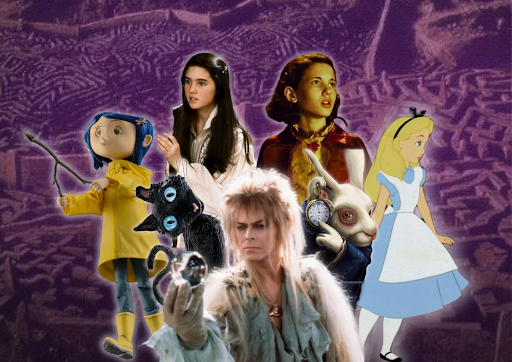

Coraline, Alice in Wonderland, Labyrinth, and Pan’s Labyrinth are just as intriguing to me now as they were in my childhood. The creatures, magical worlds, unique heroines, and their adventures! While each film has unique characters and places, they all have one thing in common. The plot is either literally or metaphorically centered on a labyrinth.
The main characters in Labyrinth (Sarah Williams) and Pan’s Labyrinth (Ofelia) are in literal labyrinths. Sarah is sent into an actual labyrinth with creatures, puzzles, and tricks to rescue her little brother from Jareth the Goblin King. While Ofelia discovers an underworld labyrinth garden where a magical creature claims she is the lost princess who must complete three tasks to prove her royalty.
The main characters in Alice in Wonderland (Alice) and Coraline (Coraline Jones) aren’t in a literal labyrinth with never-ending walls. Instead, they are in another world where the exit is not the same as the entrance. Alice falls into Wonderland, meeting creatures and exploring its various locations. Coraline is in an identical house/property that she believes is an improvement on her actual bland, boring one. Basically, Stranger Things season one. Wonder how the Duffer Brothers came up with that one…
While all these young heroines were on a journey to escape their own labyrinths, the genre also carries broader implications for girlhood. Before connecting those strings, it’s important that we differentiate between a maze and a labyrinth. Get excited ladies, we’re going back to the medieval ages and ancient Greece!
A Short History of Labyrinths
One of the earliest instances of the word "labyrinth" comes from the Middle English variation "labyrinthine." It describes intricate passageways. The first structure known as a labyrinth was an enormous building in Northern Egypt around 2000 BCE. The late traveler, Strabo, confirmed the tale of the building from the unreliable storyteller, Herodotus. He described the building as “work equal in scope to the pyramids”. The structure was used by many royals and leaders of the time. Of course, the name didn’t quite stick, but the most important takeaway is its existence for other models of labyrinths to come.
The labyrinth most people are familiar with today comes from a Cretan legend/myth. This story has many different narratives. Alan Wall, writer for The Fortnightly Review, tells the main premise as follows: The Athenians had to send seven youths and seven maidens every nine years to Knossos. They would then be inserted, one by one, into the labyrinth, the bafflingly complex structure erected by that technological genius, Daedalus.
Theseus was the son of the King of Athens, Aegeus, and offered to become one of the fourteen votive offerings. While in the structure, Theseus was helped by Ariadne to eliminate her half-brother. She had fallen in love with this foreign prince at first glance, but a goddess was imposing her curse, keeping her trapped.
She supplied thread to Theseus to let him find his way out of the labyrinth after the killing. She had asked only that he take her away with him after his heroic deeds were completed. He did take her away, but abandoned her on Naxos, the first island the sailors came to after Crete.
The main takeaway, for this article's sake, is the physical structure of this “labyrinth”. Ariadne supplied Theseus with thread so he wouldn’t get lost in the complex structure. It is also said that the youth and maidens were inserted one by one. Implying they were meant to find an exit, not an entrance.

The classical labyrinth (pictured first) has a predictable, rhythmic feel. Whoever enters has a constant path until reaching the center. A medieval pattern (pictured second) tends to feel more disorienting without rhyme to the steps or pathways.
Most notably, notice the entrance to each. The center of these labyrinths acts as the goal. You’ll still have to retrace your steps to get out, but the goal isn’t an exit or the opposite of the entrance. Once you’ve begun, you cannot retrace your steps or hit a dead end. This will only lead you further from the goal.
A maze traditionally has an entrance and exit. You can retrace your steps if you run into a dead end, and you can even get so turned around that you arrive at the entrance again. But once you’ve found the exit, you don’t go back in. The goal is the exit, so you're now out of the puzzle.
Why Girlhood Isn’t a Maze
Girlhood is generally defined as the period in a girl's life before she reaches adulthood or womanhood. You usually make mistakes and learn skills for later years in your life. That's the hidden beauty of girlhood. You can make mistakes without too harsh of consequences. Instead of consequences, you are met with a lesson and new skills to take with you in future challenges.
But you're never done learning. Once you’ve completed your own heroine's journey, life throws another one at you. The goal isn’t the exit. The goal will forever be the center. You will constantly get to the center and learn a lesson. Then retrace your steps and what you did right or wrong in the scenario. But once you're done retracing, a new goal awaits in the center. The only difference is now you know how much water to bring or what shoes to wear while trekking past the walls of the labyrinth.
Alice is a perfect example of this. Alice enters her labyrinth, Wonderland, by falling into the world. She is met with a challenge right away. The dilemma of being too big to fit through the tiny door. She finds what seems to be a solution: a bottle with the words “Drink me” on it. She is now tiny enough to fit through the door, but she notices a key to the door is on a table that she cannot reach. In the moment, Alice sees an easy solution without considering other avenues of success. Her solution comically created a new challenge. This pattern continues throughout the film before she finally returns to reality. She makes mistakes, but ultimately is not in any real danger because of them in the end.
Escapism and Guidance
Ofelia is a similar example but presents another tie to girlhood. Lack of guidance and mental isolation. Alice was accompanied by many characters throughout her journey, yet her journey was ultimately in her own mind. To me, this is a direct point of the mental isolation young girls and women face. Traditionally, women were expected to fulfill certain roles. Ofelia is quite literally seeing her mother in these roles and using her mind as an escape. In the end, we see that all the “choices” she has made without guidance put her in an unforgiving position. It is arguable that she was just using a form of escapism to cope, and her stepfather was the true evil. But if the world around her weren’t so overbearing, she wouldn’t have resorted to escapism and fantasy lands in the first place.

The lack of guidance Ofelia had could be tied to real-life examples of dangerous choices or people young girls face when adult guidance is unavailable. Drugs, predators, and unsafe situations. Obviously, an adult cannot spoon-feed a young child every answer to every challenge they face. But some people do steer impressionable young girls down the wrong path, with or without intent. That’s why it is so important for young girls to have a strong, reliable adult figure for guidance in girlhood.
A popular example in Labyrinth is the scene in which Sarah eats a peach and falls unconscious. In the film, it is Jareth's ploy to distract her from the 13-hour time limit he has imposed. In a literal sense, many see it as a reference to nonconsensual sexual acts. The peach acts as a drugged substance or edible object from a trusted “friend”, and Jareth acts as a predator. Many attribute the ending of the ballroom scene to the strongest piece of evidence. All of the guests' hands touch Sarah as she yells for them to stop. Then she wakes up confused in an unfamiliar, chaotic location.
Did Curiosity Really Kill The Cat
Young girls tend to be curious or have an urge for more, like Coraline. Her curiosity guides her in the film. She is eager and curious to explore a more exciting “world”. She indulges in this fantasy world and gets to experience all of her wildest dreams. Yet in the end, she realizes all the glitz and glamour cost her what really mattered.
Womanhood actually poses a similar ideal. In girlhood, specifically in your late teens, control seems limited. You’re old enough to be employed, cook your own meals, and be left alone. But you are still ultimately under your guardians' “rules” until you are of legal age to leave or pursue higher education. But womanhood is portrayed in the media as the kumbaya of understanding and harmony in a woman's life. While many do achieve a great social, work, and personal life, it seems to happen like magic through social media nowadays.
What social media doesn’t document are the actual struggles and tribulations young women are faced with today. But young girls don’t yet have the tools to differentiate that. They see the image of control in every aspect and idolize it. Much like the heroines in these films. None of the characters are forced into their labyrinths (Sarah being the obvious exception). They are simply curious about the unknown.
Curiosity is driven by the desire to fill a knowledge gap in our minds. Once that gap is satisfied or “filled,” we are no longer intrigued by its mystery, or the rose colored glasses come off. For characters like Coraline or Sarah, curiosity may have killed the cat.
In the last few seconds of Coraline, the black cat disappears behind the Pink Palace sign. Implying Coraline is not truly safe from the other mother. That there are other ways she can return to her world or lure her in once more. So while Coraline is back in her reality, she will never truly return to the reality before discovering the other “upside-down” world.
The last scene of Labyrinth shows Sarah reunited with the creatures of the labyrinth in her bedroom. But most concerningly, the last few frames show a white owl watching through her window. Implying Jareth is still keeping close watch of her. She will never truly escape, just like Coraline.

These endings feel reminiscent of girlhood and womanhood. As I touched on earlier, you're never out of the labyrinth. You are constantly gaining more knowledge and experience to help you trek through the miles of walls and tricks. So, while curiosity COULD kill the cat, I believe the characters are just evolving in their own way. They have faced an experience that forever changed them. In the words of Kelly Clarkson, what doesn’t kill you makes you stronger.
Closing Thoughts
To wrap up, I’d like to leave you with a quote from Girl On Film. We have all met a wannabe Tyler Durden or a man who has Fight Club as his top four on Letterboxd. It is also common for Prisoners or Inception to be favored by a male audience. These stories rely heavily on what is going on inside a man's mind. Purely internal instead of external. So I leave you with this quote to think about how girlhood and womanhood are a never-ending labyrinth.
“Men are so encouraged in the misogynistic society we live in not to be vulnerable and talk about their feelings and therefore their minds become this difficult space to navigate filled with difficult hidden things. But we women are not trapped in our minds. You could argue that we're trapped in a world that those other minds created.”
Sources
Wall, A. (2012, March). Clues and labyrinths. The Fortnightly Review. https://fortnightlyreview.co.uk/2012/03/labyrinth/
The Forest Labyrinth. Labyrinth types.
https://forestlabyrinth.ca/learn/labyrinth-types-history/
Girl On Film. (2026, January 25). Why women love labyrinth movies. YouTube. https://youtu.be/krOUNsdLztI

0 Comments
There are no comments yet. Be the first one to post one!