
The Art of Looking Outward: An Interview with Astrophotographer Nayyar Badu By Georgia Stewart
Photographs capture a moment in time, but Nayyar Badu uses astrophotography to capture moments that may have occurred millions of years before his image was made. Rather than simply photographing the night sky, Badu spends entire nights collecting fragments of ancient light. His process sits somewhere between science and art. Spending years looking into the night sky has helped Badu perfect his practice, but has also changed his perspective on the world he views it from.
Since he was a child, Badu has always been fascinated by space, and his experience in astrophotography started with just a phone camera. Astrophotography became a more serious practice for Badu when he began studying physics and astrophysics at university. There was one night in particular when Badu went outside to photograph the northern lights, and he realized he wanted to invest in better equipment for himself. What initially started as a curiosity quickly became a long-term, committed practice.

Nayyar Badu, Widefield Sadr Region, 2026.
"This is a large region of Cygnus, containing a lot of red gas. This comes from hydrogen which is ionized by photons emitted by nearby massive stars, and when this energy is re-emitted, it shows up as a beautiful pink/red color.”
Unlike typical photography, where a photo can be taken in an instant, astrophotography requires a much longer process. In order to produce a readable image of an object in space, Badu must essentially spend all night outside with his equipment, taking shots every five minutes and calibration frames to eliminate potential flaws in his camera and capture as much light as possible. After Badu collects all his images, he uses software to combine them into a master image. Badu explained that the combining of all of the images is the most creative part of the process, because this is where he brings out color and details. Even in this creative state, Badu strongly intends to keep the images as authentic as possible. His goal is to reveal space, not fabricate it.
Badu views astrophotography as inseparable from science and art, both of which are essential. Physics helps determine what can be observed and how, and artistic judgment shapes how viewers ultimately experience it. This technical mastery alone is not the only reason that Badu continues this work; he feels deeply connected to and drawn to the objects he photographs.

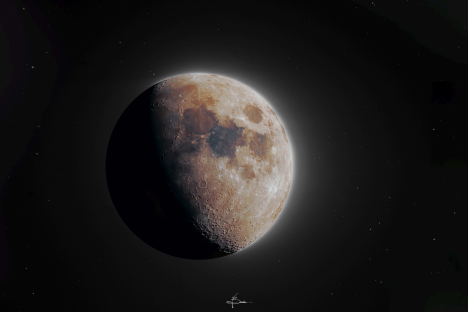
Nayyar Badu, Mineral Moon, 2026
"The Moon is our nearest cosmic neighbor, and every time you look at it, it may seem white/grey, but with careful processing and multiple pictures, you can bring out the subtle mineral colors, deposited on its surface by countless asteroid impacts."
Unlike most photographers, Badu’s subjects are far beyond physical reach. Every image is the result of light traveling unimaginable distances before reaching the camera. Badu spends entire nights photographing and observing these places that he can never visit. This creates an interesting relationship built solely on observation rather than proximity between the photographer and the subject. Somehow, this distance has created an even deeper sense of connection and appreciation for Badu.
Observing giant galaxies also means observing history. For example, Badu mentioned that the star Betelgeuse is reaching the end of its lifespan. He explained that it makes him feel weird to think about the fact that it could die and we wouldn’t know for over 600 years. Badu explained
that he could photograph something that no longer exists and not even know it, which both fascinates and unsettles him.

Nayyar Badu, Andromeda Galaxy, 2025
"Andromeda is the closest major galaxy to the Milky Way. It's a spiral galaxy and a bit bigger than ours, and is on a collision course with us!"
Each time Badu looks into the sky, he is reminded just how massive the universe is and how small our planet and even our entire galaxy are in comparison. The scale of the universe is incomprehensible, and this has reshaped how Badu views human life. Badu expressed that seeing the world from this perspective makes him disheartened by the conflicts and problems, such as violence and pollution, that exist on Earth. He explained the utter awe he feels when he thinks about just how rare and special we are to exist in the perfect conditions that can support not only life but also conscious, emotional, complex beings like humans. He has developed a deeper appreciation for the only home humanity shares, explaining that we need to care for it because we have nowhere else to go.

Nayyar Badu, Milky Way, 2025
"The Milky Way is our home galaxy, in which every star you've ever seen exists. The core is visible by eye from dark skies, and it is one of the most beautiful sights in the sky."
Each astrophotograph that Badu takes is a merge of the present and light that has existed for potentially millions of years. Despite the incredible technology and technical precision involved, what continues to draw Badu back is the sense of wonder it makes possible. Photographing places this far away has reshaped the way Badu positions himself within the universe. He views astrophotography as a form of therapy, where looking outwards can actually help him value home more deeply. Capturing these images is more than an achievement; it is also the cultivation of a journey that began millions of years ago, one that can simultaneously help us find meaning in the small corner of the universe we call home.
See more of Nayyar Badu on his social media and website:
Instagram: @astronayyar
TikTok: @astronayyar
0 Comments
There are no comments yet. Be the first one to post one!